
List of paintings
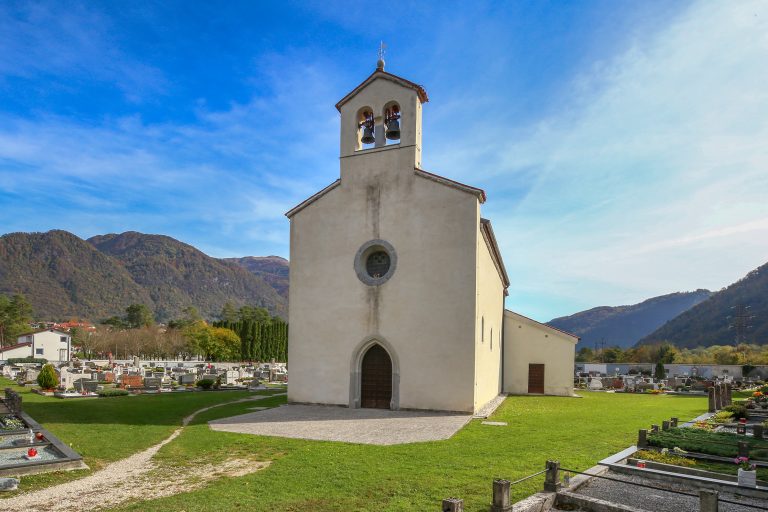
According to the historical tradition, the current Church of St Ulrich in the cemetery below the town was the original seat of the parish of Tolmin, dating back to at least the 10th century.[1] It was first mentioned in 1278 when the Patriarch installed a vicar there and the church was dedicated to St Martin.[2] In Tolmin, the dedication to St Ulrich was first confirmed in 1438, when the vicariate was declared (provisio ecclesie Sancti Odorici de Tulmino).[3] Based on the slightly more detailed visitation of 1570, it is possible to conclude that the change of dedication took place at the main altar, which mentioned two saints, possibly St Martin and St Ulrich. No other altar dedicated to St Martin existed in the church. In this case, St Ulrich could be an example of a co-dedication eventually superseding the original dedication.[4] During the construction of the present chancel around 1470, St Ulrich was undoubtedly already the predominant saint, as we can find his depiction on the vault’s apex keystone, while St Martin was relegated to a row of others at the side.[5] The church had been the seat of the parish until 1687 when the latter was transferred to the new Parish Church of St Mary’s Assumption in Tolmin.[6]
________________________________________
[1] HÖFLER 1997, pp. 136–138. For more information about the history of the church, cf. HÖFLER 2016, p. 152; HÖFLER 2022, p. 53.
[2] The dedication to St Martin was confirmed when the vicariate of Tolmin was granted to the priest Janez of Lavariano in 1278 (vicariam ecclesie sancti Martini de Tulmini); see Biblioteca Comunale Udine, Ms. 1471/I, foll. 53v–54r. Quoted after HÖFLER 2016, p. 152; cf. HÖFLER 2022, p. 53. A church with the same dedication was mentioned again in 1322, during the inspection of the unfinished brick bridge over the river Soča, but that was most likely a reference to the Church of St Maurus in today’s town of Most na Soči. More about this in HÖFLER 2022, p. 53.
[3] Faustino NAZZI, Storia religiosa del Distretto di Tolmino dalle origini al 1751, Cividale 2009, p. 6; HÖFLER 2016, p. 152; HÖFLER 2022, p. 53.
[4] The introduction of the dedication can be attributed to one of the patriarchs with that name, either Ulrich I of Eppenstein (1086–1121) or more probably Ulrich II of Treven (1086–1121); see HÖFLER 2022, p. 53.
[5] HÖFLER 2016, p. 152; HÖFLER 2022, p. 53.
[6] HÖFLER 2022, p. 53; cf. HÖFLER 2016, p. 152.
Around 1470, a Gothic chancel with a sacristy was added to the spacious church nave of Romanesque origin with a reconstructed open Mediterranean roof, well-preserved small semicircular windows with painted interior jambs, and a semicircular portal in the northern wall.[1] The chancel was built by one of the Upper Carniolan construction workshops that also expanded their activities to the Littoral region in the second half of the 15th century.[2] At that point, the chancel was painted in its entirety, while the vault, where the murals are best preserved, was designed according to the principles of the so-called Carniolan chancel.[3] The frescoes on the northern wall are dated 1472 in red paint in the middle of their lower border.[4] The sacristy was probably rebuilt in the 19th century when a side chapel was added to the northern wall of the nave, or it may be the result of renovations after World War I.[5] The church was severely damaged during the war, but the extensive reconstruction during the Italian administration saved the decaying monument.[6]
________________________________________
[1] Apart from the historical tradition, the Romanesque origin of the nave is also confirmed by the traces of graves next to the church with finds from the Old Slavic Carantanian / Köttlach culture (10th/11th century), discovered on the site; see HÖFLER 2016, p. 152. The nave of the church is divided by five funnel-shaped windows (three on the southern wall and two on the northern wall), whose painted decoration is the only of its kind in this area. The original church probably also had painted walls, as indicated by the fragment found in the middle of the northern wall; see HÖFLER 1997, pp. 136–137. For more information about the construction of the chancel, see PESKAR 1999, p. 292.
[2] The chancel is divided by three original windows in the eastern wall. The Gothic entrance to the sacristy on the southern wall is original as well; see HÖFLER 1997, pp. 136–137. It is a two-bay chancel terminated by five sides of an octagon and a vault with parallel ribs in the shape of a star. The external articulation is limited to the profiled stringcourse and three ogival biforas in the eastern wall. The present ogival portal with moulded jambs and the round window in the western nave wall have resulted from renovations. Inside, the nave and the chancel are separated by an ogival triumphal arch with geometric mouldings, not visible in the old photographs taken after the church had been damaged during the war; see PESKAR 1999, p. 292; cf. MOSCHETTI 1932, pp. 532–537.
[3] Cf. especially STELE 1924, pp. 204–205; HÖFLER 1997, pp. 136–138.
[4] HÖFLER 1997, pp. 136–138. For more information about this, see “The state of research and bibliography” section.
[5] PESKAR 1999, p. 292.
[6] MLADENOVIČ, GOVŽE, OSOJNIK 2014, p. 264.
The first authors to write about the Church of St Ulrich paid the most attention to the building’s chancel with its elaborate architectural sculptures and murals. The frescoes were first inventoried by Andrea Morassi[1] and France Stele[2] in the 1920s, as well as by Andrea Moschetti[3] ten years later. At that time, some of the colour surfaces that have since faded were still visible, while certain scenes that no longer exist were still recognisable. France Stele and Emilijan Cevc attempted to establish a connection between the frescoes in the chancel in Tolmin and those in Zgornje Jezersko and on the Križna Gora hill above Škofja Loka,[4] while Janez Höfler noticed similar figures of angels playing music on the vault of the sacristy of the Gorizia Cathedral, the former Chapel of St Agathius.[5] Ksenija Rozman included the chancel murals in the overview of the painting in the Slovenian territory from the 15th to the 16th century in her doctoral thesis;[6] Primož Kuret wrote about the musical instruments appearing on these murals;[7] while in 1988, Emilijan Cevc discussed the latter in his overview of medieval art in the Upper Soča river basin, the Vipava Valley, and the Goriška Brda hills.[8] The last expert to focus on the mural more closely was Janez Höfler in the catalogue unit of the collection Srednjeveške freske v Sloveniji. Primorska. (Medieval Frescoes in Slovenia. The Littoral Region).[9]
In the relevant literature, the church in Tolmin is also well known for its architectural sculptures in the chancel. The rich decorations and figural keystones were already described by Antonio Morassi,[10] while later, they were examined by Emilijan Cevc in particular.[11] Ivan Komelj included the Gothic chancel in the Church of St Ulrich in his overview of Gothic architecture in the Slovenian territory,[12] while Robert Peskar was the last to discuss it as part of his work on the Gothic architecture in the Goriška region.[13] In the relevant literature, we can note some discrepancies regarding the dating of the Romanesque church nave. Based on the 19th-century notes by Simon Rutar[14] – who assumed that the Patriarch of Aquileia Ulrich (1086–1121), the owner of a summer mansion in Tolmin, had had the Church of St Ulrich dedicated to his patron saint – Marijan Zadnikar dated the church nave to the 12th century.[15] However, based on archaeological research and conservation and restoration works, it can be dated to the 11th century or perhaps even the 10th century.[16]
The church is also mentioned in the overviews of art in the Slovenian Littoral region[17] and in the general Slovenian art-historical overviews.[18] Particularly Janez Höfler devoted much attention to historical sources and the history of both the church and the diocese. He focuses on these topics in two publications, which have recently been revised, amended, and published in a new edition.[19]
CEVC 1994
Emilijan CEVC, Poznogotske freske na Križni Gori pri Škofji Loki, Zbornik za umetnostno zgodovino, 20, 1944, pp. 32–70.
CEVC 1963 a
Emilijan CEVC, Od kod je bil doma mojster križnogorskih fresk?, Loški razgledi, 10/1, 1963, pp. 104–112.
CEVC 1963 b
Emilijan CEVC, Srednjeveška plastika na Slovenskem. Od začetkov do zadnje četrtine 15. stoletja, Ljubljana 1963.
CEVC 1966
Emilijan CEVC, Slovenska umetnost, Ljubljana 1966.
CEVC 1967
Emilijan CEVC, Gotsko kiparstvo, Ljubljana 1967 (Ars Sloveniae).
CEVC 1988
Emilijan CEVC, Arte medioevale nell’alto Isontino, nel Collio e nella valle del Vipacco, La cultura slovena nel Litorale, Gorizia 1988, pp. 53–76.
HÖFLER 1997
Janez HÖFLER, Srednjeveške freske v Sloveniji. 2: Primorska, Ljubljana 1997.
HÖFLER 2016
Janez HÖFLER, O prvih cerkvah in župnijah na Slovenskem. K razvoju cerkvene teritorialne organizacije slovenskih dežel v srednjem veku, Ljubljana 20162.
HÖFLER 2022
Janez HÖFLER, Historična topografija predjožefinskih župnij na Slovenskem. Primorska: Oglejski patriarhat, Tržaška škofija, Ljubljana 20223.
KOMELJ 1973
Ivan KOMELJ, Gotska arhitektura na Slovenskem. Razvoj stavbnih členov in cerkvenega prostora, Ljubljana 1973.
KURET 1973
Primož KURET, Glasbeni instrumenti na srednjeveških freskah na Slovenskem, Ljubljana 1973.
MLADENOVIČ, GOVŽE, OSOJNIK 2014
Ajda MLADENOVIČ, Špela GOVŽE, Minka OSOJNIK, Tolmin, Varstvo spomenikov. Poročila, 49, 2014, pp. 264–267.
MORASSI 1922–1923
Antonio MORASSI, Chiese gotiche in Val d’Isonzo, Architettura e arti decorative, 6, 1922–1923, pp. 177–189.
MORASSI 1923–1924
Antonio MORASSI, Restauri e scoperte di pitture nella Venezia Giulia, Bollettino d’Arte, s. 2, 3, 1923–1924, pp. 419–432.
MOSCHETTI 1932
Andrea MOSCHETTI, I danni ai monumenti e alle opere d’arte delle Venezie nella guerra mondiale MCMXV–MCMXVIII, Venezia 1932.
PESKAR 1995
Robert PESKAR, Tolmin, p. c. sv. Urha: prezbiterij, Gotika v Sloveniji (ed. Janez Höfler), Narodna galerija, Ljubljana 1995, pp. 97–98.
PESKAR 1999
Robert PESKAR, Gotska arhitektura na Goriškem. Stavbarske delavnice 1460–1530, Nova Gorica 1999.
ROZMAN 1964
Ksenija ROZMAN, Stensko slikarstvo od 15. do srede 16. stoletja na Slovenskem. Problem prostora, Ljubljana 1964 (doctoral dissertation typescript).
RUTAR 1882
Simon RUTAR, Zgodovina Tolminskega, Gorica 1882.
STELE 1924
France STELE, Varstvo spomenikov, Zbornik za umetnostno zgodovino, 4, 1924, pp. 203–208.
STELE 1960
France STELE, Umetnost v Primorju, Ljubljana 1960.
TAVANO 1988
Sergio TAVANO, I monumenti fra Aquileia e Gorizia 1856–1918, Udine-Gorizia 1988.
ZADNIKAR 1982
Marijan ZADNIKAR, Romanika v Sloveniji. Tipologija in morfologija sakralne arhitekture, Ljubljana 1982.
________________________________________
[1] MORASSI 1922–1923, p. 183. Morassi believes that the frescoes originate from the late 15th century and that they possess a German or northern character, though featuring Italian influences; see MORASSI 1923–1924, pp. 427–432.
[2] STELE 1924, pp. 204–205, partially reconstructed the iconographic scheme according to the system of the Carniolan chancel and dated the murals to the beginning of the 16th century.
[3] MOSCHETTI 1932, pp. 532–537.
[4] STELE 1924, pp. 204–205; CEVC 1944, pp. 65–69. In the subsequent work CEVC 1963 a, p. 108, the author no longer attributed the frescoes in Tolmin and on the Križna Gora hill to the same master. Instead, he stated that the Tolmin frescoes had been painted thirty years later and, although they exhibited the tendencies of realism, they did not point to the Križna Gora painter. Emilijan Cevc also saw the influence of “Italian or at least South Tyrolean blood” in them, while, in his opinion, the author of the Križna Gora frescoes originated from Bavaria.
[5] HÖFLER 1997, pp. 137–138.
[6] ROZMAN 1964, p. 31.
[7] KURET 1973, pp. 35, 71, 93, 97.
[8] CEVC 1988, p. 73.
[9] HÖFLER 1997, pp. 136–138.
[10] MORASSI 1923–1924, pp. 429.
[11] CEVC 1963 b, pp. 256, 269–270; CEVC 1967, p. XIX.
[12] KOMELJ 1973, pp. 32, 230, 282.
[13] PESKAR 1999, pp. 291–292.
[14] RUTAR 1882, p. 31.
[15] ZADNIKAR 1982, pp. 558–559; PESKAR 1999, p. 291.
[16] PESKAR 1999, p. 291; HÖFLER 2016, p. 152; HÖFLER 2022, p. 53.
[17] STELE 1960, pp. 51, 67–68, 86–87.
[18] CEVC 1966, pp. 37, 57.
[19] HÖFLER 2016 , p. 152; HÖFLER 2022, p. 53.
In the monograph Historična topografija predjožefinskih župnij na Slovenskem. Primorska, Janez Höfler focused on the historical sources.[1] According to him, the Church of St Ulrich in Tolmin is mentioned in the following visitations:
1570: the visitation report by Bartolomeo de Portia, Abbot of Moggio (Možnica, Možac) and the Apostolic Visitator of the Diocese of Aquileia for the Austrian part;[2]
1651 and 1668: a list of dioceses, provostries, abbeys, etc., in Styria, Carinthia, Carniola, the Goriška region, Trieste, Rijeka, Bovec, and Cividale;[3]
1747, 1755, 1761, and 1777: visitation records of the Tolmin Archdeaconate in the Parish Archives in Tolmin;[4]
1755: a visitation protocol of the Archdeaconate of Tolmin by the Archbishop of Gorizia Karl Michael Attems;[5]
1762: a visitation protocol of the Archdeaconate of Gorizia, Tolmin, and Duino by the Archbishop of Gorizia Karl Michael Attems.[6]
________________________________________
[1] HÖFLER 2022, p. 53.
[2] Biblioteca Comunale Udine, Fondo Principale, Ms. 1039. Janez Höfler cites the source after the microfilm kept in the Archives of the Republic of Slovenia, where the list of parishes, chapels, and curacy benefices – Nomina plebium, cappelarum, seu beneficiorum curatorum in Illustrissimo comitatu Goriciae, foll. 201v–202r – is referred to as Nomina 1570. Quoted after HÖFLER 2022, p. 31.
[3] Steiermärkisches Landesarchiv, Gradec, Handschriften Buergergasse, Kirchliche Angelegenheiten III.a.4, Beschreibung oder Matricula der geistlichen Lehenschaften als Bistumben, Propsteÿen, Abbteÿ, Prelaturen, Commenden, Privraten, Collegien, Guardianaten, Pfarren, Vicariaten, Filialen und allen Beneficien simplicien oder Curaten in Steÿr, Khärndten, Crain, Görz, Triest, St. Veith am Pflaumb, Flitsch, Cividall. Janez Höfler cites the source after microfilm photographs. The list was commissioned by Emperor Ferdinand III in 1649. It was initiated in 1650 and completed in 1657, but it also contains subsequent entries. In 1668, the archdeaconates of Tolmin and Gorizia were inventoried yet again, while the section dedicated to the diocese of Trieste was created after 1660 – probably in 1666, as its abstract kept in the Slivje Parish Archive is dated (the typescript data regarding the architectural history of churches with citations of published or unpublished sources by Božidar Premrl). For the part focusing on Aquileia (1651), see the German and Italian versions (the latter is more thorough and comprehensive). Quoted after HÖFLER 2022, p. 32.
[4] HÖFLER 2022, p. 33.
[5] Archivio arcivecovile Gorizia, Sign. 8(23); the source was published in Karel Mihael ATTEMS, Atti delle visite pastorali negli arcidiaconati di Gorizia, Tolmino e Duino dell’arcidiocesi di Gorizia/Vizitacijski zapisniki goriškega, tolminskega in devinskega arhidiakonata goriške nadškofije/Die Berichte der Pastoralvisitationen in den Archidiakonaten Görz, Tolmin und Duino der Erzdiözese Görz 1750–1759 (edd. Franc Kralj, Luigi Tavano), Gorizia 1994. Quoted after HÖFLER 2022, p. 33.
[6] Archivio arcivescovile Gorizia, Sign. 13(28), 16(31), 17(32), 20(35), 26(41), 27(42), 28(43); the source was published in Karel Mihael ATTEMS, Atti delle visite pastorali negli arcidiaconati di Gorizia, Tolmino e Duino dell’arcidiocesi di Gorizia/Vizitacijski zapisniki goriškega, tolminskega in devinskega arhidiakonata goriške nadškofije/Die Berichte der Pastoralvisitationen in den Archidiakonaten Görz, Tolmin und Duino der Erzdiözese Görz 1762–1773 (edd. Franc Kralj, Luigi Tavano), Gorizia 2000. Quoted after HÖFLER 2022, p. 34.
The church was severely damaged during World War I. The decaying monument was saved by extensive reconstruction and restoration under the auspices of the Italian administration.[1] The competent regional office of the Institute for the Protection of Cultural Heritage of Slovenia has no information about the works taking place in the church until 2012 when the post-earthquake renovation began. Before the conservation and restoration work started, construction works had been carried out. The building was newly plastered with rough and fine plaster.[2] The murals in the chancel had only been superficially uncovered and poorly presented in the past: the paintings were still covered with a thin coat of whitewash, with polychromy seeping through. Between June and September 2012, the murals in the chancel were uncovered from underneath the recent coats of whitewash and secondary plaster and presented in their entirety. The retouching in the line drawing technique was carried out only on the largest complete scene of Christ with the Cross on the southern wall and the three apostles under the southern window of the three-side conclusion.[3] A fragment of an older mural in the nave was cleaned and the vault keystones were probed, which turned out to be entirely polychrome.[4] Simultaneously, conservation and restoration interventions were carried out on the stone exterior elements, namely the three stone Gothic windows,[5] quoins, the portal, and the profiled stone stringcourse of the chancel.[6] The modelling of the missing details, whose structure was approximated to the originals and retouched where necessary, was completed. The joints between the individual elements were filled with identical mass in a slightly lighter tone. The stone window frame, tracery, and dividing columns were painted in brick colour, thus approximating the colour preserved on the tracery in the shape of a triple fish bladder. In 2014, stained-glass windows were installed.[7]
________________________________________
[1] MLADENOVIČ, GOVŽE, OSOJNIK 2014, p. 264.
[2] MLADENOVIČ, GOVŽE, OSOJNIK 2014, p. 264.
[3] The frescoes in the chancel are an exquisite work of art, probably painted by an artist trained in the North, as the design in the style of the German late Gothic realism and the realistically convincing figures already exude a spirit akin to the Renaissance; see MLADENOVIČ, GOVŽE, OSOJNIK 2014, p. 264.
[4] MLADENOVIČ, GOVŽE, OSOJNIK 2014, p. 264.
[5] Each of the windows features distinct tracery: a triple fish bladder, a trefoil, and a four-part rosette; see MLADENOVIČ, GOVŽE, OSOJNIK 2014, p. 264.
[6] MLADENOVIČ, GOVŽE, OSOJNIK 2014, p. 264.
[7] MLADENOVIČ, GOVŽE, OSOJNIK 2014, p. 267.


Legal Terms of Use
© 2026 ZRC SAZU UIFS, Corpus picturarum muralium medii aevi
ZRC SAZU
France Stele Institute of Art History
Novi trg 2
1000 Ljubljana


Spodaj seznam podrobno opisuje piškotke, ki se uporabljajo na našem spletnem mestu.
| Cookie | Type | Duration | Description |
|---|---|---|---|
| _ga | Non-Necessary | 2 years | This cookie is installed by Google Analytics. The cookie is used to calculate visitor, session, camapign data and keep track of site usage for the site's analytics report. The cookies store information anonymously and assigns a randoly generated number to identify unique visitors. |
| _gat | Non-Necessary | 1 minute | Google uses this cookie to distinguish users. |
| _gid | Non-Necessary | 1 day | This cookie is installed by Google Analytics. The cookie is used to store information of how visitors use a website and helps in creating an analytics report of how the wbsite is doing. The data collected including the number visitors, the source where they have come from, and the pages viisted in an anonymous form. |
| cookielawinfo-checkbox-necessary | Necessary | 1 year | This cookie is set by GDPR Cookie Consent plugin. The cookies is used to store the user consent for the cookies in the category "Necessary". |
| cookielawinfo-checkbox-non-necessary | Necessary | 1 year | This cookie is set by GDPR Cookie Consent plugin. The cookies is used to store the user consent for the cookies in the category "Non Necessary". |
| CookieLawInfoConsent | Necessary | 1 year | The cookie is used to store the summary of the consent given for cookie usage. It does not store any personal data. |
| PHPSESSID | session | Time of session | Cookie stores information about the user's session and allow users to keep their entries during the time of visiting the website. |
| pll_language | Necessary | 1 year | This cookie is used to remember any selection a user has made about language. |
| show_preloader_once | Necessary | Session | With this cookie we remember the user's first visit. |
| viewed_cookie_policy | Necessary | 1 year | The cookie is used to store whether or not you have consented to the use of cookies. It does not store any personal data. |

