
List of paintings

Very little historical information has been preserved about the Church of St Brice in Volarje.[1] The church used to belong – and still does – to the parish of Tolmin.[2] However, the restoration interventions carried out in the late 1990s and in 2012 indicate that the original architecture was still Romanesque and that the building was most probably constructed in the 13th century.[3] The oldest direct information about its architectural history is the year 1475 on the exterior of the chancel, testifying to the time of its construction, while the mason’s mark on a chancel keystone attests to its architect, the builder Andrej (Andreas) of Loka.[4] The frescoes in the interior are attributed to Master Jernej (Bartholomew) of Loka and were probably painted around 1525.[5]
________________________________________
[1] The information about the dedication of the Church of St Brice in Volarje on 27 August 1486 by the visitator Bishop Pietro Carlo comes from the manuscript materials of the Kobarid Dean, Msgr. Franc Rupnik, which are stored in the Kobarid Parish Archives. This dedication is not recorded in Santonino’s diary, nor could it have possibly taken place on that day, as at the time, the visitator was in Kred, where he consecrated the Church of St Hilary. A day later, he arrived in Kobarid and stopped in Tolmin in the evening. In case it was not a mistake, the dedication of the church in Volarje could only have taken place on the afternoon of 29 August or before noon on 30 August, before Carlo continued his journey to Cerkno. Cf. Giuseppe VALE, Itinerario di Paolo Santonino in Carintia, Stiria e Carniola negli anni 1485–1487 (Codice Vaticano Latino 3795), Città di Vaticano 1943, pp. 175–177; HÖFLER 2018, pp. 25, 75; HÖFLER 2022, p. 55.
[2] HÖFLER 2022, p. 55.
[3] In 1997, during the restoration works, two faces outlined in black and a consecration cross painted on the original rough plaster were discovered on the southern wall of the nave, indicating that the nave wall was significantly older than the chancel and that it probably dated back to the Romanesque period; see ČERV 1998, p. 143. For more information about the restoration works on the oldest layer, see JAZBEC 2001, p. 143.
[4] CEVC 1960, p. 100; cf. HÖFLER 1997, p. 141; ČERV 1998, p. 142; PESKAR 1999, p. 71.
[5] STELE 1924, p. 205, already noticed that the entire chancel had been painted even though the frescoes had been whitewashed after the war. He attributed them to the so-called Master of the Chancel of St Oswald, later known as Jernej (Bartholomew) of Loka. Based on the frescoes by the same painter in the Church of St Daniel in Volče, where the year 1526 was still visible before the war, Stele dated them to the third decade of the 16th century. In Volarje, Jernej of Loka’s paintings were found in the chancel, on the triumphal arch, and on both walls of the nave. The murals in the Volarje chancel rank among the most comprehensively preserved Jernej’s works with a complex design; see HÖFLER 1997, pp. 99–100. About the iconography of the murals, see HÖFLER 1997, pp. 141–143; cf. ČERV 1998, pp. 142–143. For more information and an overview of the relevant literature, see “The state of research” section.
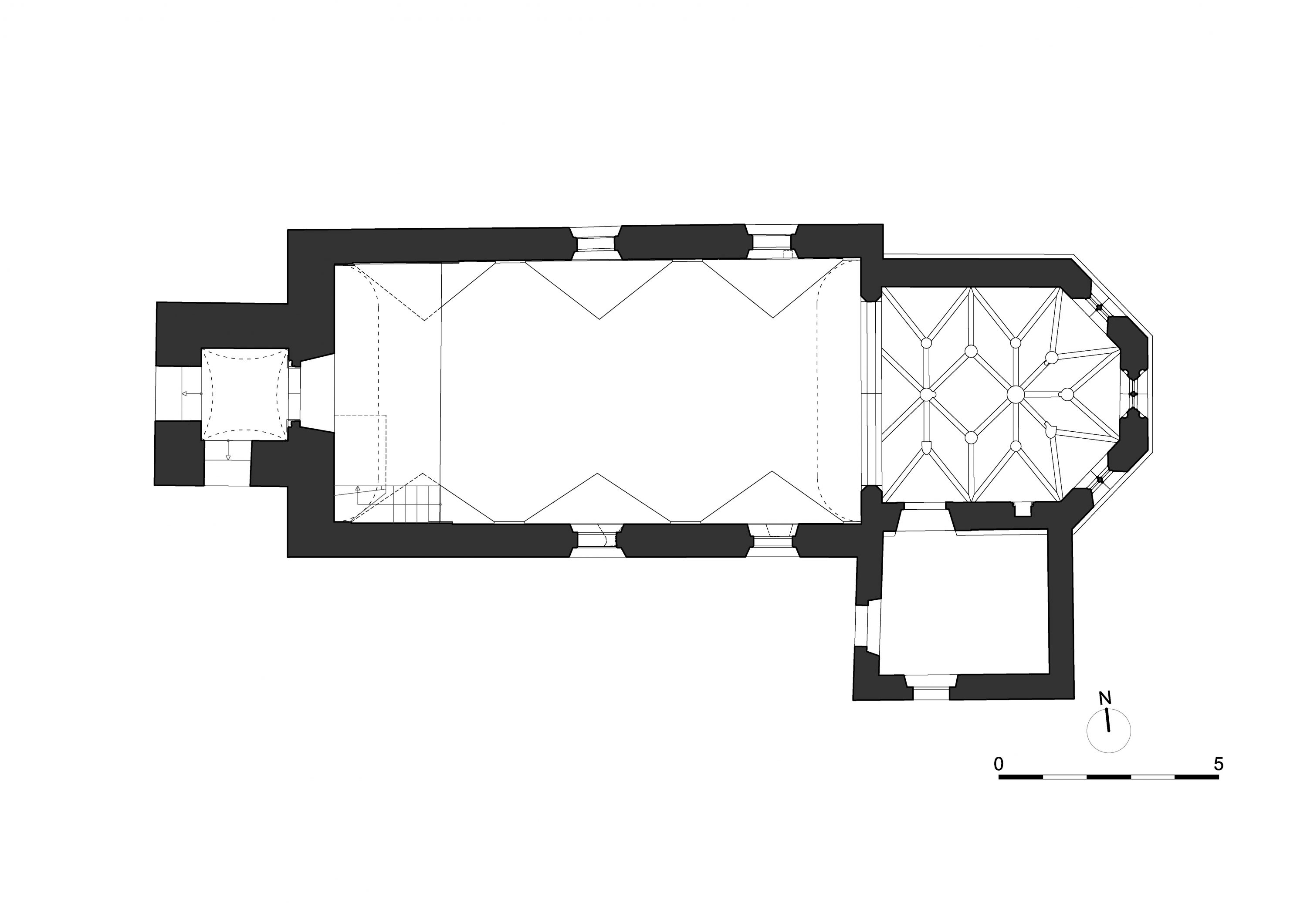
The originally Romanesque church nave was heightened and extended during Gothicisation,[1] while a new late Gothic chancel was constructed in 1475 by the builder Andrej of Loka.[2] During the Baroque period, new windows were added, while in the 19th century, the nave walls were heightened, probably due to the change in roof pitch. Likely, the belfry was also added at that time, replacing an earlier bell-gable whose remains have been incorporated into the eastern wall of the belfry.[3] In the late 19th or early 20th century, new windows were added to the nave walls and the northern wall of the chancel; the two Gothic side windows were redesigned (the middle one was walled up); the sacristy was added; and the exterior was newly plastered.[4]
________________________________________
[1] ČERV 1998, p. 142; JAZBEC 2001, p. 143.
[2] The first to include it among the works of Andrej (Andreas) of Loka was Emilijan CEVC 1960, p. 99; cf. also CEVC 1992, p. 61. The late Gothic chancel features a vaulted ceiling with parallel ribs in the shape of a star and is terminated by three sides of an octagon with three large Gothic windows. It is separated from the nave by an ogival triumphal arch with geometric mouldings. The Virgin with Child, St Brice, St Andrew, and St Margaret are depicted on the keystones in the chancel, followed by the escutcheons featuring Andrej of Loka’s mason’s mark and the coat of arms of the Formentini noble family; see CEVC 1975, pp. 48. The chancel exterior is articulated by a stringcourse and three ogival windows in the end walls, featuring preserved fragments of sandstone tracery; see PESKAR 1999, pp. 306–307; cf. JAZBEC, ZBAČNIK, OSOJNIK 2014, p. 240.
[3] HÖFLER 2022, p. 55, states that the church was extended in 1888 and that a new belfry was supposedly constructed at that time. This information cannot be found anywhere else in the relevant literature, and its origin remains unknown.
[4] JAZBEC, ZBAČNIK, OSOJNIK 2014, p. 240.
The first references to the Volarje Church of St Brice in the relevant literature are closely connected to the local wall paintings, which, in 1924, France Stele attributed to the Master of the Chancel of St Oswald, later known as Jernej (Bartholomew) of Loka, and dated them to the third decade of the 16th century.[1] Furthermore, France Stele wrote about the murals in Volarje in connection with the abovementioned Master in the Glasnik Muzejskega društva za Slovenijo newsletter a year later; in the overview of Slovenian medieval painting titled Monumenta artis Slovenicae in 1935; in the monograph Umetnost v Primorju in 1960; and in the overview of painting in Slovenia between the 12th and 16th century in 1969.[2] As a part of the painter’s opus, the murals are also mentioned by Emilijan Cevc in his painting overviews;[3] Mojca Jenko in her master’s thesis on Jernej of Loka;[4] and Dušan Koman in his guide to the painter’s work in the Loka area.[5] The restoration interventions related to the Volarje frescoes until 1996 and the works of Jernej from Loka in the basin of the river Soča are also discussed in an article by Andrea Antonello.[6]
In terms of its architecture, in 1960, Emilijan Cevc included the Church of St Brice among the works of the builder Andrej of Loka, to whom he also dedicated an overview article in 1992.[7] Based on the year inscribed in the chancel, he dated the church’s construction to 1475.[8] This dating persisted in the literature until as late as the monument conservation research in the late 1990s and in 2012, which revealed that the nave was still Romanesque and that the year 1475 only referred to the construction of the chancel.[9] In 1999, Robert Peskar placed the Volarje chancel in the context of Gothic architecture in the Goriška region.[10]
In 1997, in the catalogue unit of the Srednjeveške freske v Sloveniji. Primoska collection, Janez Höfler was the first to comprehensively present the Church of St Brice in Volarje with an emphasis on the frescoes,[11] while in 2006, Anabelle Križnar focused on the technical analysis of the mural layers on the southern nave wall in her monograph Slog in tehnika srednjeveškega stenskega slikarstva na Slovenskem.[12] In 2001, Janez Höfler published the sources and known historical information about the church in his monograph Gradivo za historično topografijo predjožefinskih župnij na Slovenskem. Primorska. In 2022, the revised and updated online edition of this work was published.[13]
ANTONELLO 1995
Andrea ANTONELLO, Il restauro degli affreschi di San Brizio a Volarje ed altre considerazioni su Bartolomeo da Loka in Val d’Isonzo, Studi goriziani, 82, 1995, pp. 13–33.
CENČIČ, NAGLOST 1998
Miran CENČIČ, Anton NAGLOST, Volarje, Varstvo spomenikov. Poročila, 37, 1998, p. 142.
CEVC 1957
Emilijan CEVC, Goriška v slovenski umetnostni preteklosti, Goriški zbornik 1947–1957 (ed. Joško Humar) Nova Gorica 1957, pp. 30–42.
CEVC 1960
Emilijan CEVC, Stavbar Andrej in slikar Jernej iz Loke v Beneški Sloveniji, Loški razgledi, 7/1, 1960, pp. 94–105.
CEVC 1963
Emilijan CEVC, Srednjeveška plastika na Slovenskem. Od začetkov do zadnje četrtine 15. stoletja, Ljubljana 1963.
CEVC 1967
Emilijan CEVC, Slovenska umetnost, Ljubljana 1967.
CEVC 1975
Emilijan CEVC, Po sledeh stavbarja Andreja iz Loke, Loški razgledi, 22, 1975, pp. 47–56.
CEVC 1988
Emilijan CEVC, Arte medioevale nell’alto Isontino, nel Collio e nella valle del Vipacco, La cultura slovena nel Litorale, Gorizia 1988, pp. 53–76.
CEVC 1992
Emilijan CEVC, Prispevek Andreja iz Loke slovenski gotski arhitekturi, Po poteh Andreja iz Loke. Umetnostni in kulturni stiki med Furlanijo in Slovenijo od XV. do XVIII. stoletja (ed. Gian Carlo Menis), Špeter/S. Pietro di Natisone 1992, pp. 57–83.
ČERV 1998
Robert ČERV, Volarje, Varstvo spomenikov. Poročila, 37, 1998, pp. 142–143.
ČERV 2001
Robert ČERV, Volarje, Varstvo spomenikov. Poročila, 38, 2001, p. 143.
HÖFLER 1997
Janez HÖFLER, Srednjeveške freske v Sloveniji. Primorska, Ljubljana 1997.
HÖFLER 2001
Janez HÖFLER, Gradivo za historično topografijo predjožefinskih župnij na Slovenskem. Primorska: Oglejski patriarhat, Goriška nadškofija, Tržaška škofija, Ljubljana 2001.
HÖFLER 2018
Janez HÖFLER, Oglejski generalni vikarji in drugi patriarhovi pooblaščenci na Slovenskem v poznem srednjem veku (1300–1535), Ljubljana 2018.
HÖFLER 2022
Janez HÖFLER, Historična topografija predjožefinskih župnij na Slovenskem. Primorska: Oglejski patriarhat, Tržaška škofija, Ljubljana 20223.
JAZBEC 2001
Andrej JAZBEC, Volarje, Varstvo spomenikov. Poročila, 38, 2001, p. 143.
JAZBEC, ZBAČNIK, OSOJNIK 2014
Andrej JAZBEC, Brane ZBAČNIK, Minka OSOJNIK, Volarje – cerkev sv. Brikcija, Varstvo spomenikov. Poročila, 49, 2014, pp. 239–243.
KOMELJ 1973
Ivan KOMELJ, Gotska arhitektura na Slovenskem. Razvoj stavbnih členov in cerkvenega prostora, Ljubljana 1973.
KRIŽNAR 2006
Anabelle KRIŽNAR, Slog in tehnika srednjeveškega stenskega slikarstva na Slovenskem, Ljubljana 2006.
MOSCHETTI 1932
Andrea MOSCHETTI, I danni ai monumenti e alle opere d’arte delle Venezie nella guerra mondiale MCMXV–MCMXVIII, Venezia 1932.
PERGAR, NAGLOST 1998
Rudi PERGAR, Toni NAGLOST, Volarje, Varstvo spomenikov. Poročila, 37, 1998, p. 142.
PESKAR 1999
Robert PESKAR, Gotska arhitektura na Goriškem. Stavbarske delavnice 1460–1530, Nova Gorica 1999.
SMOLE 1967
Emil SMOLE, Konservatorska poročila. Umetnostni in urbanistični spomeniki. Volarji pri Tolminu, Varstvo spomenikov, 11/1966, 1967, p. 167.
STELE 1924
France STELE, Varstvo spomenikov, Zbornik za umetnostno zgodovino, 4, 1924, pp. 203–208.
STELE 1924–1925
France STELE, Slikar Jernej iz Loke, Glasnik Muzejskega društva za Slovenijo, 4–6, 1924–1925, pp. 24–31.
STELE 1935
France STELE, Monumenta artis Slovenicae. 1: Srednjeveško stensko slikarstvo, Ljubljana 1935.
STELE 1960
France STELE, Umetnost v Primorju, Ljubljana 1960.
STELE 1969
France STELE, Slikarstvo v Sloveniji od 12. do srede 16. stoletja, Ljubljana 1969.
URŠIČ 1987
Mojca URŠIČ, Jernej iz Loke, Ljubljana 1987 (master’s thesis typescript).
________________________________________
[1] STELE 1924, p. 205. The existence of murals in the Church of St Brice in Volarje was already reported by Josip Kragelj in 1910, in the 13th issue of the magazine Voditelj v bogoslovnih vedah. However, the frescoes were later whitewashed again; quoted after ČERV 1998, pp. 142–143. The Volarje murals are also mentioned in MOSCHETTI 1932, pp. 537–538.
[2] STELE 1924–1925, p. 26; STELE 1935, p. 2; STELE 1960, p. 84; STELE 1969, p. 226.
[3] CEVC 1957, p. 36; CEVC 1967, p. 75; CEVC 1988, p. 73.
[4] URŠIČ 1987, pp. 20, 222–223.
[5] Dušan KOMAN, Slikar Jernej iz Loke in njegova dela na Loškem. Škofja Loka 2011.
[6] ANTONELLO 1995, pp. 13–33.
[7] CEVC 1960, pp. 99–100; CEVC 1992, p. 61. About the beginnings of the research into the opus of Andrej of Loka, see France STELE, Epigrafične drobtine, Zbornik za umetnostno zgodovino, 5, 1925, pp. 43–49.
[8] CEVC 1960, pp. 99–100.
[9] Cf. ČERV 1998, pp. 142–143; JAZBEC 2001, p. 143; JAZBEC, ZBAČNIK, OSOJNIK 2014, pp. 239–243. The star-shaped chancel vaulting by Master Andrej of Loka can also be found on the list of Gothic church architecture monuments in the Littoral Region and Inner Carniola with Bloke; see KOMELJ 1973, p. 283.
[10] PESKAR 1999, pp. 306–307.
[11] HÖFLER 1997, p. 141.
[12] KRIŽNAR 2006, pp. 78, 81–83, 106, 108, 270–273.
[13] HÖFLER 2001, pp. 79–80; HÖFLER 2022, p. 55.
The written sources known so far – mainly visitation reports and diocese censuses – are presented in Janez Höfler’s monograph Historična topografija predjožefinskih župnij na Slovenskem. Primorska: Oglejski patriarhat, Tržaška škofija.[1] According to the author, the Church of St Brice in Volarje is mentioned in the following sources:
1570: the visitation report of Bartolomeo de Portia, Abbot of Moggio (Možnica, Možac) and Apostolic Visitator of the Diocese of Aquileia for the Austrian part;[2]
1651 and 1668: a list of dioceses, provostries, abbeys, etc., in Styria, Carinthia, Carniola, the Goriška region, Trieste, Rijeka, Bovec, and Cividale;[3]
1747, 1755, 1761, and 1777: visitation records of the Tolmin Archdeaconate in the Parish Archives in Tolmin;[4]
1751: the visitation protocol of a part of the Archdeaconate of Tolmin by the Apostolic Vicar Karl Michael Attems, Bishop of Pergamon and Archbishop-designate of Gorizia;[5]
1755: the visitation protocol of the Archdeaconate of Tolmin by the Archbishop of Gorizia Karl Michael Attems;[6]
1762: the visitation protocol of the Archdeaconate of Gorizia, Tolmin, and Duino by the Archbishop of Gorizia Karl Michael Attems;[7]
1782: a tabular list of parishes, sub-parishes, vicariates, and branches of the Archdiocese of Gorizia in the territory of the County of Gorizia.[8]
________________________________________
[1] In 1751 and 1782, the church’s dedication to St Bartholomew was mentioned; see HÖFLER 2022, p. 55.
[2] Biblioteca Comunale Udine, Fondo Principale, Ms. 1039. Janez Höfler cites the source after a microfilm kept in the Archives of the Republic of Slovenia, where the inventory of parishes, chapels, and curacy benefices – Nomina plebium, cappelarum, seu beneficiorum curatorum in Illustrissimo comitatu Goriciae, foll. 201v-202r – is referred to as Nomina 1570; cf. Lucia PILLON, “Cum palla lignea picta et deaurata”, Segni del Sacro. Scultura lignea nel Goriziano tra Spätgotik e Rinascimento (ed. Walter Klainscek), Castello di Gorizia, Sala degli Stati Provinciali, Foresteria e Carceri, Monfalcone 1997, pp. 32–51, with bibliography. Quoted after HÖFLER 2022, p. 31.
[3] Steiermärkisches Landesarchiv, Graz, Handschriften Buergergasse, Kirchliche Angelegenheiten III.a.4, Beschreibung oder Matricula der geistlichen Lehenschaften als Bistumben, Propsteÿen, Abbteÿ, Prelaturen, Commenden, Privraten, Collegien, Guardianaten, Pfarren, Vicariaten, Filialen und allen Beneficien simplicien oder Curaten in Steÿr, Khärndten, Crain, Görz, Triest, St. Veith am Pflaumb, Flitsch, Cividall. Janez Höfler cites the source after microfilm. The list was commissioned by Emperor Ferdinand III in 1649. It was initiated in 1650 and completed in 1657, but it also contains subsequent entries. In 1668, the archdeaconates of Tolmin and Gorizia were inventoried yet again, while the section dedicated to the diocese of Trieste was created after 1660 – probably in 1666, as its abstract kept in the Slivje Parish Archive is dated (the typescript data regarding the architectural history of churches with citations of published or unpublished sources by Božidar Premrl). Quoted after HÖFLER 2022, p. 32.
[4] HÖFLER 2022, p. 33.
[5] Archivio arcivescovile Gorizia, Sign. 6(21); the source was published in Karel Mihael ATTEMS, Atti delle visite pastorali negli arcidiaconati di Gorizia, Tolmino e Duino dell’arcidiocesi di Gorizia/Vizitacijski zapisniki goriškega, tolminskega in devinskega arhidiakonata goriške nadškofije/Die Berichte der Pastoralvisitationen in den Archidiakonaten Görz, Tolmin und Duino der Erzdiözese Görz 1750–1759 (edd. Franc Kralj, Luigi Tavano), Gorizia 1994. Quoted after HÖFLER 2022, p. 33.
[6] Archivio arcivescovile Gorizia, Sign. 8(23); the source was published in Karel Mihael ATTEMS, Atti delle visite pastorali negli arcidiaconati di Gorizia, Tolmino e Duino dell’arcidiocesi di Gorizia/Vizitacijski zapisniki goriškega, tolminskega in devinskega arhidiakonata goriške nadškofije/Die Berichte der Pastoralvisitationen in den Archidiakonaten Görz, Tolmin und Duino der Erzdiözese Görz 1750–1759 (edd. Franc Kralj, Luigi Tavano), Gorizia 1994. In this source, the church is apparently mentioned as the Church of St Bartholomew. Quoted after HÖFLER 2022, p. 33.
[7] Archivio arcivescovile Gorizia, Sign. 13(28), 16(31), 17(32), 20(35), 26(41), 27(42), 28(43); the source was published in Karel Mihael ATTEMS, Atti delle visite pastorali negli arcidiaconati di Gorizia, Tolmino e Duino dell’arcidiocesi di Gorizia/Vizitacijski zapisniki goriškega, tolminskega in devinskega arhidiakonata goriške nadškofije/Die Berichte der Pastoralvisitationen in den Archidiakonaten Görz, Tolmin und Duino der Erzdiözese Görz 1762–1773 (edd. Franc Kralj, Luigi Tavano), Gorizia 2000. Quoted after HÖFLER 2022, p. 34.
[8] In this source, the church is apparently mentioned as the Church of St Bartholomew; see HÖFLER 2022, p. 34.
The frescoes in the church were probed and prepared for uncovering as early as 1966,[1] while major restoration interventions and uncoverings were completed between 1993 and 1998. At that time, frescoes depicting scenes from the life of St Brice by Master Jernej of Loka were uncovered and restored in the chancel and on the triumphal arch, while three walled-up Gothic windows were discovered, opened, and restored to their original form.[2] Fragments of murals on the southern wall of the nave were also found and protected, while all the layers of older plasters with depictions of consecration crosses and older figurative elements were presented as well.[3]
Further construction and renovation works were carried out in 2012 as part of the post-earthquake rehabilitation of the church.[4] In the same year, the missing decorative triumphal arch murals and the dividing bands were reconstructed (retouching with varnish and line drawing).[5] Preliminary probing revealed fragments of murals on the southern exterior of the nave and on the northern interior wall. The latter was presented in the same manner as the southern nave wall: Gothic plasters with sinopia and mural fragments were displayed; and where the upper layers were not preserved, the Romanesque consecration crosses were presented.[6] As part of the renovations of the northern wall of the nave, interventions were carried out on the side altar mensa in the corner by the triumphal arch. As the existing concrete mensa did not match the style of the church, a partially preserved older one was found, whose missing part was reconstructed and plastered.[7] On the southern exterior of the church, several layers of medieval plasters and fragments of two frescoes were found in the area of the former Romanesque nave, probably depicting Luxuria (possibly painted by Jernej of Loka) and St Christopher (most likely by a 15th-century Friulian painter). Another smaller scene was preserved to the upper left of the depiction of St Christopher,[8] while an inscription in large red capital letters was found on the church’s Gothic plaster to the left of Luxuria. The plasters and whitewashes from the Modern Period were removed, as were the more recent Baroque patchworks. A decision was made to present the remains of both frescoes in the reconstructed fields in the original size. The Passion scene under the south-eastern chancel window was also uncovered, strengthened, documented, and covered again.[9]
________________________________________
[1]SMOLE 1966–1967, p. 167.
[2] PERGAR, NAGLOST 1998, p. 142.
[3] CENČIČ, NAGLOST 1998, p. 142; ČERV 1998, pp. 142–143; ČERV 2001, p. 143.
[4] JAZBEC, ZBAČNIK, OSOJNIK 2014.
[5] JAZBEC, ZBAČNIK, OSOJNIK 2014, p. 240.
[6] Based on the details (especially the curtains near the floor and the drawing depicting horsemen), the restorers attribute the fragments discovered on the northern wall to the same Friulian painter from the first half of the 15th century as the murals on the southern wall; see JAZBEC, ZBAČNIK, OSOJNIK 2014, p. 240.
[7] JAZBEC, ZBAČNIK, OSOJNIK 2014, pp. 240–243.
[8] Only a part of the decorative border and the sketched outline on the Romanesque façade have been preserved; see JAZBEC, ZBAČNIK, OSOJNIK 2014, p. 243.
[9] JAZBEC, ZBAČNIK, OSOJNIK 2014, p. 243.

Legal Terms of Use
© 2026 ZRC SAZU UIFS, Corpus picturarum muralium medii aevi
ZRC SAZU
France Stele Institute of Art History
Novi trg 2
1000 Ljubljana


Spodaj seznam podrobno opisuje piškotke, ki se uporabljajo na našem spletnem mestu.
| Cookie | Type | Duration | Description |
|---|---|---|---|
| _ga | Non-Necessary | 2 years | This cookie is installed by Google Analytics. The cookie is used to calculate visitor, session, camapign data and keep track of site usage for the site's analytics report. The cookies store information anonymously and assigns a randoly generated number to identify unique visitors. |
| _gat | Non-Necessary | 1 minute | Google uses this cookie to distinguish users. |
| _gid | Non-Necessary | 1 day | This cookie is installed by Google Analytics. The cookie is used to store information of how visitors use a website and helps in creating an analytics report of how the wbsite is doing. The data collected including the number visitors, the source where they have come from, and the pages viisted in an anonymous form. |
| cookielawinfo-checkbox-necessary | Necessary | 1 year | This cookie is set by GDPR Cookie Consent plugin. The cookies is used to store the user consent for the cookies in the category "Necessary". |
| cookielawinfo-checkbox-non-necessary | Necessary | 1 year | This cookie is set by GDPR Cookie Consent plugin. The cookies is used to store the user consent for the cookies in the category "Non Necessary". |
| CookieLawInfoConsent | Necessary | 1 year | The cookie is used to store the summary of the consent given for cookie usage. It does not store any personal data. |
| PHPSESSID | session | Time of session | Cookie stores information about the user's session and allow users to keep their entries during the time of visiting the website. |
| pll_language | Necessary | 1 year | This cookie is used to remember any selection a user has made about language. |
| show_preloader_once | Necessary | Session | With this cookie we remember the user's first visit. |
| viewed_cookie_policy | Necessary | 1 year | The cookie is used to store whether or not you have consented to the use of cookies. It does not store any personal data. |

