
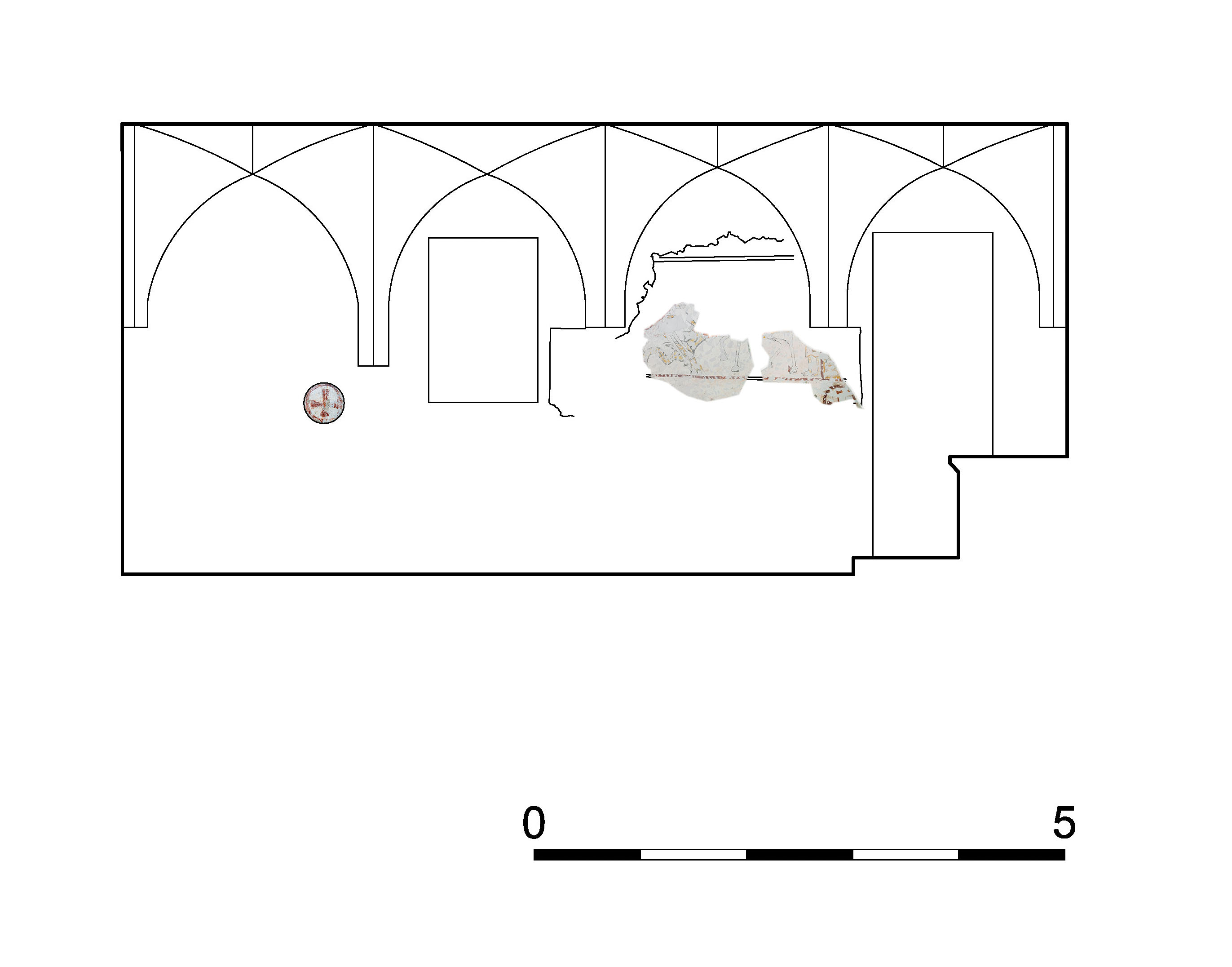


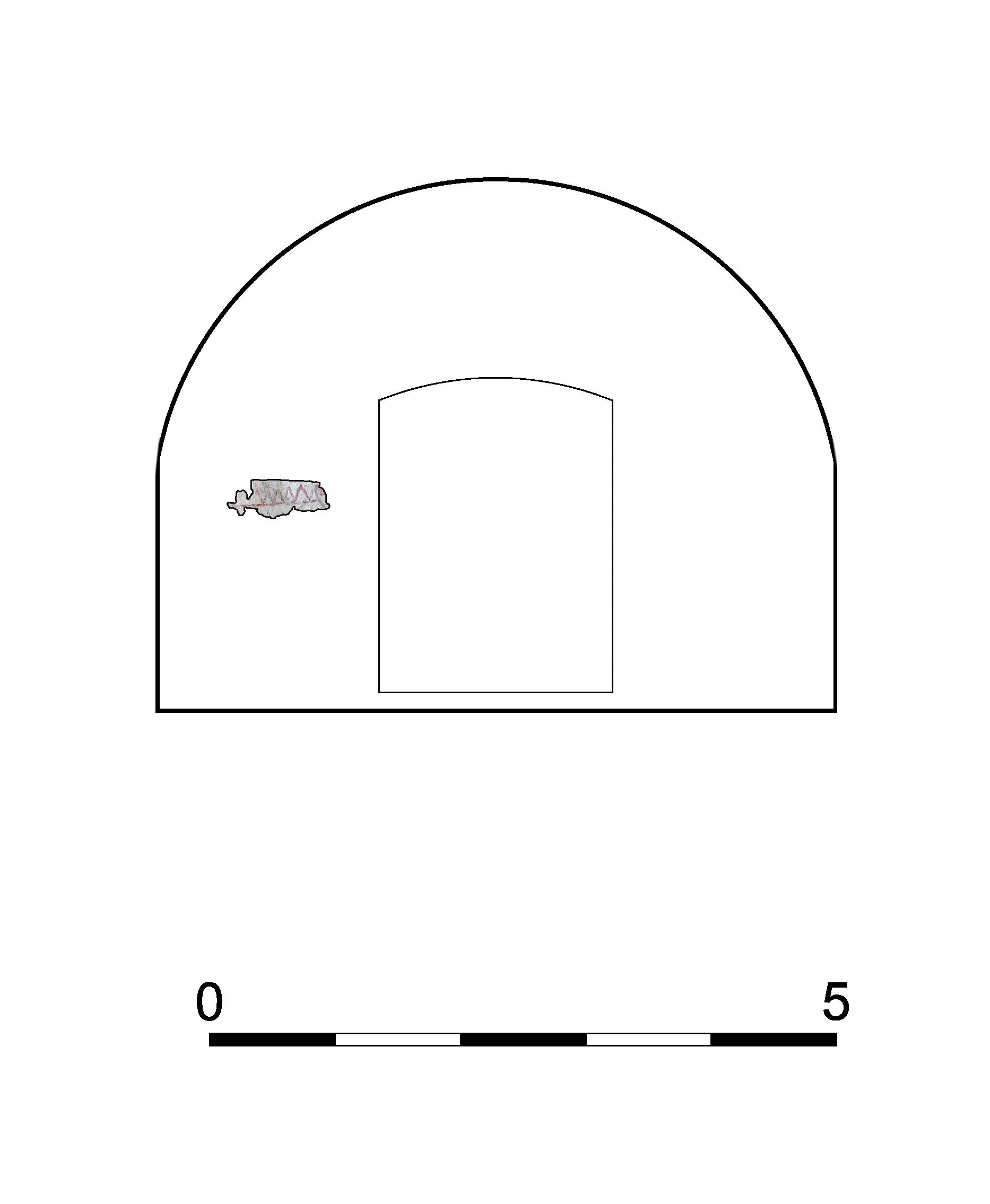
Of the older mural layer, only the lower two parts of a pair of horses, facing each other in profile, are discernible on the northern wall of the nave. Of the horse on the left, only the front legs and the bottom part of its open mouth with reins remain, while only the legs of the horse on the right are visible. A distinctive yellow-green dragon with a gaping snout is discernible under the legs of the left horse. The dragon’s throat is pierced by the spear of a horseman (?), obscured by the newer mural layer. To the right of the second horse, it is possible to make out the lower part of a barefoot figure dressed in a coat, facing the horse on the left.[1] A part of the brown bordure is visible at the lower edge of the composition, while below it, on the same mural layer, the upper part of a consecration cross has been preserved on the right side.[2] On the left part of the western wall of the nave, next to the church portal, a small fragment of a straight, thickened line with a series of triangles is still visible. Together with the preserved consecration crosses on the southern nave wall, this element is undoubtedly a part of the older mural layer.
________________________________________
[1] HÖFLER 1996, p. 151, described this fragment as well but did not yet mention the second horse with the dragon.
[2] HÖFLER 1996, p. 151.
Inside the church, two layers of figural depictions are visible on the northern wall of the nave. Both are only fragmentarily preserved or still partly covered with the more recent plaster. A part of the mural was also destroyed by the end of the vault. Only the lower part of the scene depicted by the older mural layer is visible, as it is partly obscured by the more recent layer. The top colour layer has fallen off in some places, while the black outlines remain recognisable.[1] The larger yellow and green surfaces and the brown-red band running along the lower part of the scene have been preserved, while under it, on the right side of the same mural layer, the upper part of the consecration cross has been preserved.[2] The fragments of the consecration cross on the southern wall and the zigzag band on the western wall of the nave probably also belong to the older mural layer.
________________________________________
[1] Cf. the description in ZIMMERMANN 1996, p. 224.
[2] HÖFLER 1996, p. 151.
Unknown.
The equestrian scene on the northern wall of the nave was initially identified as a fragment of The Procession of the Magi.[1] However, the subsequently discovered part of the mural with the dragon called this interpretation into question. The left side of the mural is undoubtedly a fragment of the St George Fighting the Dragon scene, which was first identified by Matjaž Ambrožič.[2] It is much more difficult to identify the scene on the right. Given the pronounced juxtaposition of the horses, one would expect the mural’s composition to have been symmetrical. In this case, the other horse must have also been ridden, and a beggar can be identified beside the rider. In tandem, St George may be joined by St Martin sharing his cloak, and such an iconographic solution would also be possible in the Studenčice mural.[3]
________________________________________
[1] HÖFLER 1996, p. 151; ZIMMERMANN 1996, p. 224; cf. AMBROŽIČ 2021, pp. 133–134.
[2] AMBROŽIČ 2021, pp. 133–134. The fragment of the scene with St George belongs among the oldest examples of this iconographic motif in the territory of present-day Slovenia. Thus, in terms of the time of its creation, the Studenčice mural can be placed alongside the scene with St George in the church of St George in Trnovec near Sevnica, the fragment in the church of St John the Baptist at Lake Bohinj, and the mural in the church of St Cantianus in Vrzdenec.
[3] The possibility that this could be an example of such a scene was established during a field visit to the mural on 26 March 2021 while preparing the present digital corpus.
Pigments: presumably white lime, yellow ochre, red earth, organic black
Analytical techniques: /
As we have not been able to obtain permission to take samples, the composition of the plaster cannot be analysed. As seen in situ, it consists of lime and sand, whose dark grains are showing through the bright colour layers.
The white, yellow, red, green, and black colours have been preserved. As we could not take samples, it is impossible to conduct a chemical analysis of the pigments. Given the durability of the colours, we can assume that the pigments are suitable for the al fresco or the lime techniques. Therefore, they mostly include natural inorganic pigments such as white lime, yellow ochre, red earth, green earth or malachite, and some black organic pigment, possibly carbon black, which is most frequently found on medieval mural paintings in the territory of today’s Slovenia. The green is somewhat darker in tone, so it is probably green earth.
Without samples, the painting technique cannot be determined conclusively. Given the good preservation of the colours, the mural was probably painted using the al fresco and perhaps also the lime techniques, as a white colour layer is visible throughout the entire preserved background.
The consecration crosses on the southern and northern walls and the remnant of the zig-zag bordure on the western wall were painted in a dark red colour on a white base (probably limewash), using broad brushstrokes. There are no discernible incisions, and neither can we establish whether the bordure was painted at the same time as the mural on the northern wall. Nevertheless, the red colour of the bordure appears to be the same as the strong red contour under both scenes. The dragon was outlined using very thin incisions (Fig. 1), as were probably also the bodies of both horses and St George’s sword. However, these characteristics must be interpreted carefully, as the lines of the modern reconstruction of the bodies were also incised over the infills used to repair the missing parts of the mural. Interestingly, it appears that the horse’s legs were first drawn using a grey underdrawing that the painter later emphasised with a black final contour. The latter does not always precisely adhere to the underdrawing, as can be seen in several parts, for example on the hind leg of the horse in the supposed scene of St Martin sharing his cloak (Fig. 1). Only the lower parts of the two horses in both scenes have been preserved, and they look unnatural with their long, thin and perfectly straight legs spreading out into broad hooves. The painter outlined the animals with black strokes without any discernible colour modelling. However, a bit of colour modelling remains on the body and the right foreleg of George’s horse, which appears to have been dark ochre. Meanwhile, the remnants of the red colour on the body could belong to the decorative cover of George’s horse, which terminates in a zig-zag. Both George’s and Martin’s horses feature yellow stripes, which are still partially visible under both animals’ legs and around the neck of George’s horse. The supposed beggar on the far right of the mural is also merely outlined with a black contour. While one of his feet ends in long parallel toes, only the big toe and a part of the next toe are visible on the other. However, it seems that the two feet were painted wrong – the left on the right and vice versa. The purpose of the circles at the level of the beggar’s knees may be to define the knees, from where a broad, straight yellow line runs to the ankles. At that point, it widens to colour the ankles and then continues along the soles of the feet. This could be a sort of extremely simple colour modelling. The garment is outlined with a broad yellow stroke and finished with a black contour. There is no interior modelling. More colours have only been preserved on the dragon in the St George scene, depicted using a combination of yellow and green. Both colours were applied flatly with broad brushes. The mural is a simple linear painting dominated by broad strokes and a thick black contour.
Studenčice, Succursal church of St Florian, Stage 1 (Studenčice), 2024 (last updated 6. 1. 2025). Corpus picturarum muralium medii aevi, https://corpuspicturarum.zrc-sazu.si/en/poslikava/phase-1-studencice/ (20. 9. 2026).
Legal Terms of Use
© 2026 ZRC SAZU UIFS, Corpus picturarum muralium medii aevi
ZRC SAZU
France Stele Institute of Art History
Novi trg 2
1000 Ljubljana


Spodaj seznam podrobno opisuje piškotke, ki se uporabljajo na našem spletnem mestu.
| Cookie | Type | Duration | Description |
|---|---|---|---|
| _ga | Non-Necessary | 2 years | This cookie is installed by Google Analytics. The cookie is used to calculate visitor, session, camapign data and keep track of site usage for the site's analytics report. The cookies store information anonymously and assigns a randoly generated number to identify unique visitors. |
| _gat | Non-Necessary | 1 minute | Google uses this cookie to distinguish users. |
| _gid | Non-Necessary | 1 day | This cookie is installed by Google Analytics. The cookie is used to store information of how visitors use a website and helps in creating an analytics report of how the wbsite is doing. The data collected including the number visitors, the source where they have come from, and the pages viisted in an anonymous form. |
| cookielawinfo-checkbox-necessary | Necessary | 1 year | This cookie is set by GDPR Cookie Consent plugin. The cookies is used to store the user consent for the cookies in the category "Necessary". |
| cookielawinfo-checkbox-non-necessary | Necessary | 1 year | This cookie is set by GDPR Cookie Consent plugin. The cookies is used to store the user consent for the cookies in the category "Non Necessary". |
| CookieLawInfoConsent | Necessary | 1 year | The cookie is used to store the summary of the consent given for cookie usage. It does not store any personal data. |
| PHPSESSID | session | Time of session | Cookie stores information about the user's session and allow users to keep their entries during the time of visiting the website. |
| pll_language | Necessary | 1 year | This cookie is used to remember any selection a user has made about language. |
| show_preloader_once | Necessary | Session | With this cookie we remember the user's first visit. |
| viewed_cookie_policy | Necessary | 1 year | The cookie is used to store whether or not you have consented to the use of cookies. It does not store any personal data. |
