


Pigments: white lime, yellow ochre, red earth, green earth, umber, malachite, azurite (?), lead pigments
Techniques: OM, Raman, XRD, XRF
Already at first glance, the plaster appears very thin and only measures 2 mm in some parts. It is visible only in some sample cross-sections, while in the others, there is just a white colour layer under the colour layer, which could be either limewash or the plaster’s top layer, containing only lime. Under an optical microscope, the samples reveal a plaster that is rich in lime and contains a modest quantity of binder consisting of varicoloured angular grains (yellow, red, or black) of various sizes (Fig. 1–2). The XRD analysis has confirmed that the plaster mainly consists of lime (calcite) as the binder and a somewhat more modest quantity of quartz as the aggregate. The lime contains very little dolomite, while some impurities, mainly feldspars, are evident in the plaster. The plaster contains enough binder to bind the aggregate grains well and thus make a durable painting base. Limewash is nevertheless discernible in several areas. However, based on the cross-sections, it is not conclusive whether limewash is indeed present everywhere or if this is actually merely the top layer of the plaster, containing only lime (Fig. 3). Limewash is probably original and not from a subsequent overpainting. The plaster sample taken from the vault appears even richer in lime, while the aggregate is finer (Fig. 2). Such plaster is lighter and therefore more durable on vaults. Based on a single sample, we cannot say for certain that it is indeed different, i.e. lighter than the plaster on the chancel walls.
The mural is poorly preserved, and the colours have blurred or fallen off in many areas. Earthy tones (ochre-yellow, orange, and red) predominate, while the painter also often used green. It is unknown whether the background was originally blue, as the colour has not been preserved. The XRF analysis has revealed that the basic pigments are white lime (calcite), yellow ochre (iron), and red earth (iron). Some organic black paint, which has not yet been identified, was probably also used. The numerous black elements on both the walls and the chancel vault, such as the trees, some halos, parts of the draperies or entire tunics (the angels on the vault), and the black spots on the background draw attention. Originally, they must have been of a different colour, but it appears that certain pigments have degraded. The XRF analyses have detected lead in the samples from these blackened surfaces, while the Raman analysis has identified plattnerite. This means the lead pigment has oxidised, but it is impossible to determine whether it was lead white, yellow massicot, or red minium. Based on the diversity of the darkened elements, we can assume that the painter probably used all three. The XRF analysis has also confirmed the use of malachite both on the green areas (e.g. the stable and the floor under Mary in the Nativity scene) and on the blackened trees, which were thus originally green, painted with a mixture of malachite and some lead pigment, probably lead white (Fig. 3), which has darkened. Underneath this dark colour, a reddish surface can be discerned. Perhaps the colour layer was applied to a red underpainting, though in the sample cross-section (Fig. 3), it seems that the red is transitioning to black. This could indicate the use of minium that has oxidised. Additional analyses are still ongoing. Malachite could also have blackened and degraded to tenorite. However, since the green colour shows no major signs of change elsewhere, the darkening must have resulted from using a lead pigment. At least in some places (based on the samples, it is possible to assume that over larger surfaces), the malachite was also mixed with the chemically more stable green earth, as revealed by the sample taken from the green fence of the stable under Mary in the Nativity scene (Fig. 4). On the trees, the colour was applied in a thin layer, while on other parts – such as on the darkened flap of Mary’s coat or the green fence of the stable under Mary in the Nativity scene – the colour layer is thick (Figs. 4–5). The Raman analysis has also identified plattnerite on the blackened flap of Mary’s coat. A lead pigment, probably lead white, was also used for the colour of the carnations, made as a mixture of earth pigments (yellow ochre, red earth), white lime, perhaps a little umber for shading, and a lead pigment. The dark spots on the now bright background indicate that originally, the background was probably blue and painted with azurite, which has mostly fallen off and partly oxidised to black tenorite. The pigments were certainly impregnated with lime water or lime milk, while the parts that were finished al secco were impregnated with some organic binder, such as animal glue, casein, or egg yolk.
The mural was painted using a combination of the al secco, al fresco, and lime techniques. The painting was started al fresco, as some of the colours were applied on fresh plaster, which is evident from the lime passing into the colour layer (Fig. 4–5). However, because much of the work was completed al secco, many colour layers have peeled away, and the mural is thus poorly preserved. The al secco technique is also confirmed by the cross-sections, for example by the sample taken from the stable roof (Fig. 1b), where we can clearly see a distinct boundary between the plaster and the basic yellow colour layer. The latter is thick, indicating that some organic binder was added to the pigment. In some places, the plaster was freshened up with limewash, which can be seen in situ with the naked eye; for example, the trees were painted in this manner (Fig. 3). None of the samples supports the hypothesis that a subsequent overpainting was involved, as no other, older layers can be detected under the visible colour layers, except for either limewash or plaster.
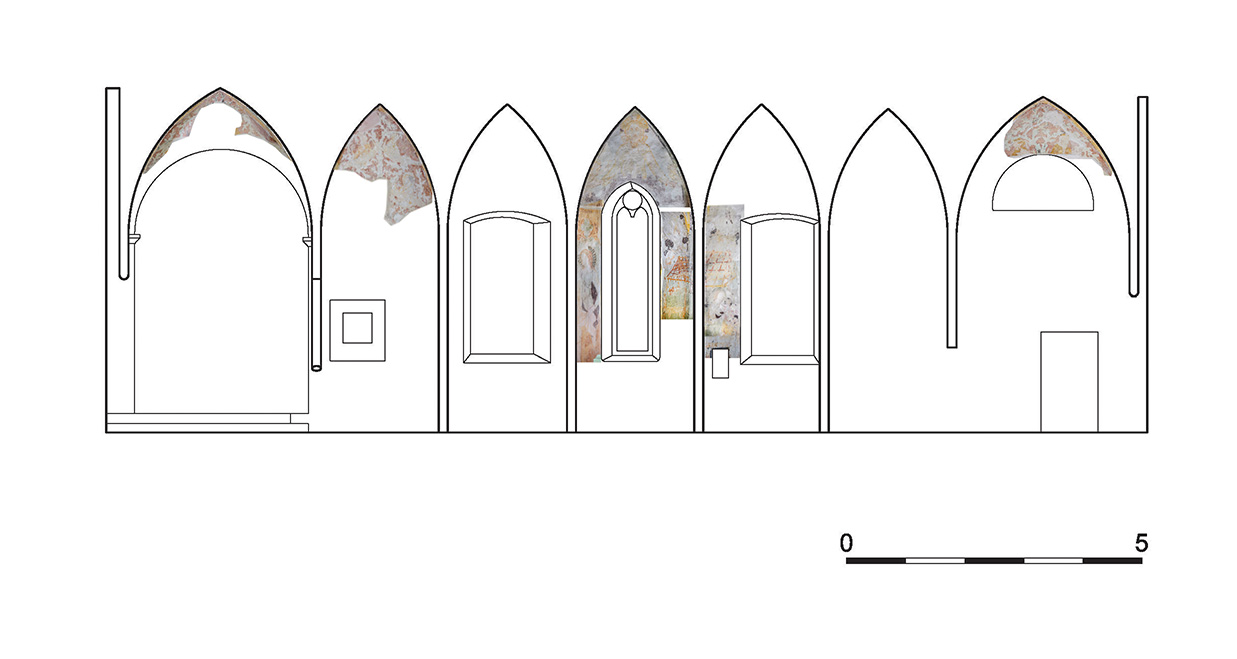
Numerous incisions and pouncings were made in the fresh plaster and are still visible on the mural. Thin but deep incisions outline all the halos and head contours. On the walls, Jesus and Mary’s halos are decorated with deep ray-shaped pouncings, while only the halos of the Child in the Nativity scene and of the Holy Trinity on the area of the eastern wall beneath the vault feature quatrefoils decorated with parallel rays, pressed into the plaster. The halos of the angels on the vault are also incised. However, only those painted on the white background also feature thin ray-shaped pouncings, while those on the red painting base do not feature any pouncings. This could indicate the work of an assistant. The symbols of the Passion of Christ, the trumpets, certain other musical instruments, and perhaps the divisions between the different colour bands are also incised on the vault. A pair of compasses was used for the halos and the basic shape of the architecture, as the incised semicircles are still clearly discernible under the colour layers (Fig. 6). As the colour layers have mostly fallen off, the strong red line used to outline the figures stands out. This could be an underdrawing, though in some places (Mary, the Holy Trinity), the preparatory drawing could also have been applied in yellow, while the red may actually be the final contour (Fig. 7). The contours could also have been painted over during restoration works, as the original ones, completed al secco, would have probably fallen off. It is also possible that both red and yellow were combined for the underdrawing. The samples also fail to resolve this dilemma. The red contour of St Joseph’s face, which could be either an underdrawing or the final contour, was applied directly to the limewash, while no other colour layer is visible underneath; it is also possible that it fell off the analysed sample. Perhaps the preparatory drawing was first painted on the plaster (in yellow?), then the limewash was applied over it, and then the red drawing was made. No underpaintings are visible unless the red background on the vault with the angels bearing the symbols of the Passion of Christ was once blue and this is actually a so-called morello (a red underpainting under the azurite). The colours were applied directly to the plaster or limewash, as can be seen in the sample cross-sections (Figs. 1–5). The painter used mainly local colours as the base for modelling. He often used yellow ochre (the hair, the stable, the architecture) and then applied darker colours on top of it. Most of the faces have not been preserved. Facial features are still vaguely discernible on some figures, while on others, they are still surprisingly clear (subsequent retouchings?). The heads of the angels on the vault and Jesus’ head appear slightly more rounded, while the heads of the other figures are elongated, featuring high foreheads and slightly narrowed chins. The eyes are large and slightly almond-shaped. The lower and upper eyelids are narrow and drawn with a thinner line. The notably semi-circular eyebrow is drawn as strongly as the outline of the eye, which it meets at the inner corner, where the contact is further accentuated with red shading. The inner eyebrow continues into a short but beautifully shaped nose, ending in the wavy line of the nostril. The forehead features a horizontal wrinkle, which is clearly one of this painter’s characteristics, as are three parallel wrinkles at the back of the neck (Figs. 6–7). The mouth is shaped around a strong central line curving slightly upwards at the corners, while the triangular accentuation of the corners creates a smile. A short, thin line outlines the heart-shaped upper lip, while a short lower line separates the lower lip from the chin. The crescent-shaped ears are modelled rather schematically. The hands are too big for the body, but they feature elegant long and narrow fingers. The faces of the angels have not been preserved. God the Father is the only figure painted en face. Beneath his high forehead, he gazes sharply at the faithful with large eyes, above which the painter modelled strong, thick eyebrows. If it ever existed, the line of the nasal ridge has not been preserved. The nasal tip is narrow, and the nostrils are elegantly outlined. Under the nose, fleshy lips are hidden behind a moustache and a beard. The face widens with cheekbones that continue into slightly protruding ears. Only a few remains of the carnation’s colour modelling, best visible on the sleeping St Joseph, have been preserved. The relevant sample cross-section has revealed that, at least in this spot, thick colour layers were applied on limewash. The base colour of the carnation is yellow, the shadows along the contours are painted with a broad brush in pink, and the shape is outlined with a red (final?) contour. The skill with which the painter modelled the ox in the stable is fascinating. He applied the same red and pink colours found on the carnations but no yellow. He modelled the animal with a broad brush in an intense pink colour and defined it with a narrower red contour. The colour has mostly fallen off the draperies. On some of the figures, only broad brushstrokes, which the painter used to create the folds, have been preserved (Figs. 6–7), while on the vault, flat-looking blackened parts of the garments and the entire tunics of the angels have been preserved. The halos, which probably used to be bright yellow (massicot), have also blackened. The colour modelling is best seen on Mary’s hair, where the painter applied the basic ochre colour with a thick brush and then modelled the strands with an increasingly thinner brush and a darker red-brown colour. The painter was obviously well-versed in combining thick and thin brushes, but we do not know if he achieved any fine transitions between the highlights and shadings.
Rovt under Menina, Succursal church of St Judoc, Stage 1 (Rovt under Menina), 2024 (last updated 5. 12. 2024). Corpus picturarum muralium medii aevi, https://corpuspicturarum.zrc-sazu.si/en/poslikava/phase-1-rovt-under-menina/ (16. 10. 2026).
Legal Terms of Use
© 2026 ZRC SAZU UIFS, Corpus picturarum muralium medii aevi
ZRC SAZU
France Stele Institute of Art History
Novi trg 2
1000 Ljubljana


Spodaj seznam podrobno opisuje piškotke, ki se uporabljajo na našem spletnem mestu.
| Cookie | Type | Duration | Description |
|---|---|---|---|
| _ga | Non-Necessary | 2 years | This cookie is installed by Google Analytics. The cookie is used to calculate visitor, session, camapign data and keep track of site usage for the site's analytics report. The cookies store information anonymously and assigns a randoly generated number to identify unique visitors. |
| _gat | Non-Necessary | 1 minute | Google uses this cookie to distinguish users. |
| _gid | Non-Necessary | 1 day | This cookie is installed by Google Analytics. The cookie is used to store information of how visitors use a website and helps in creating an analytics report of how the wbsite is doing. The data collected including the number visitors, the source where they have come from, and the pages viisted in an anonymous form. |
| cookielawinfo-checkbox-necessary | Necessary | 1 year | This cookie is set by GDPR Cookie Consent plugin. The cookies is used to store the user consent for the cookies in the category "Necessary". |
| cookielawinfo-checkbox-non-necessary | Necessary | 1 year | This cookie is set by GDPR Cookie Consent plugin. The cookies is used to store the user consent for the cookies in the category "Non Necessary". |
| CookieLawInfoConsent | Necessary | 1 year | The cookie is used to store the summary of the consent given for cookie usage. It does not store any personal data. |
| PHPSESSID | session | Time of session | Cookie stores information about the user's session and allow users to keep their entries during the time of visiting the website. |
| pll_language | Necessary | 1 year | This cookie is used to remember any selection a user has made about language. |
| show_preloader_once | Necessary | Session | With this cookie we remember the user's first visit. |
| viewed_cookie_policy | Necessary | 1 year | The cookie is used to store whether or not you have consented to the use of cookies. It does not store any personal data. |
