
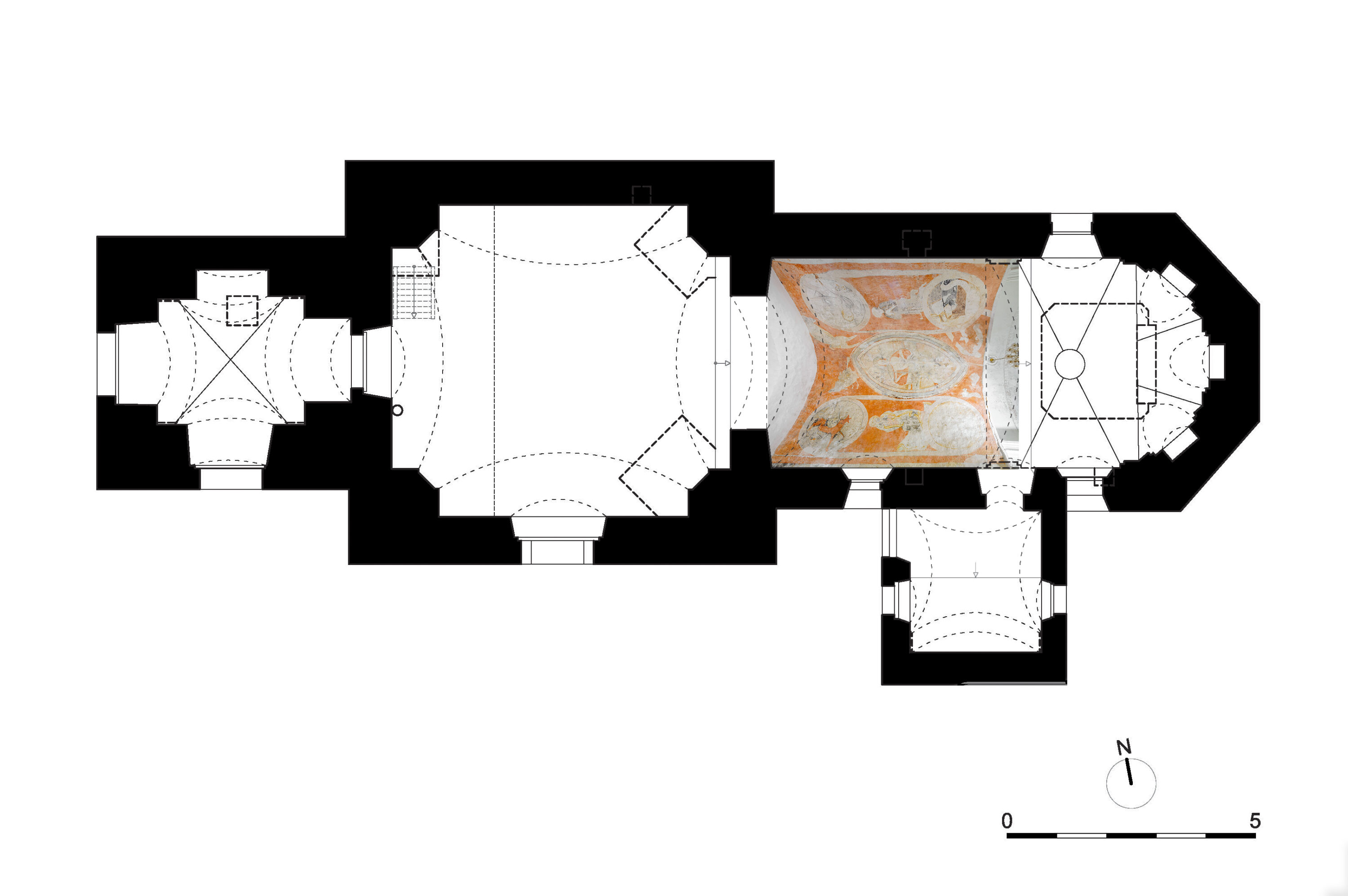

Pigments: presumably white lime, yellow ochre, red earth, some organic black pigment
Analytical techniques: /
Samples could not be acquired due to the inaccessibility of the paintings, so the precise composition of the plaster cannot be determined. Most likely, it is a standard mix of lime and sand, though the exact proportions remain unknown.
Without pigment samples, it is impossible to carry out the chemical analysis of the mural, which was also repainted subsequently. The original colour palette is modest and includes yellow, red, and black. However, it is impossible to be sure whether the yellow colour of the throne under Christ the Redeemer was applied originally or during the subsequent repainting. Due to the poor preservation, it is not clear whether the painter used any other colours. It is possible to infer the use of white lime, yellow ochre, red earth, and some organic black pigment. Meanwhile, the intense yellow lines and the grey-blue and pink colours belong to the subsequent repainting. In several places, for example on the ox, blackened areas stand out, indicating the degradation of a certain lead pigment to black plattnerite. These are most likely the pigments applied during the 17th-century repainting. The brick red colour of the background is also unusual and definitely originates from the repainting as well. The primary binder was most probably lime from the plaster.
Due to the extensive repainting, the technique used to paint the original mural cannot be determined. Judging from the still preserved colours, the mural was at least started on fresh plaster, but it is impossible to estimate how much of it was painted al secco. It is also unclear whether the new colours were applied directly to the old colour layers during the repainting of the mural or whether limewash was applied first, at least in some places. However, some of the more recent colour layers appear thick and are peeling from the vault.
The repainting makes it difficult to discern what belongs to the original work. No incisions or pouncings can be detected. The circles with the symbols of the four evangelists and the central mandorla could be incised. However, in this case, the lines must be extremely thin and covered with colour layers. On closer inspection, the original underdrawing seems to have been painted in red with the dominant black contour drawn over it. This is clearly distinguishable on the image of the eagle (Fig. 1), the central mandorla, and the face of Christ the Judge in the centre of the vault (Fig. 2). In several places, vivid yellow drawing stands out, but this is a part of the repainting and not the original work. Face modelling can only be discerned on the figure of Christ the Judge (Fig. 2). Only a hint of Mary’s face remains because it was heavily repainted with a greyish colour layer. Therefore, it is impossible to determine the details of the eyes and nose, showing from underneath this layer. Christ’s face is oval, with an unusually high forehead. The eyes are small and narrow, the eyebrows thin and only slightly arched, while the potato-shaped nose, placed in the middle, continues from both eyebrows and ends in wide nostrils. Underneath is a small red mouth, outlined with a darker central line, and a lower lip traced with the same colour. Under the tip of the nose, there is a residue of a darker colour, indicating the channel between the nose and the lips. The shape of the eyes, eyebrows, and mouth, as well as the abovementioned channel under the nose strongly resemble the waist-up figures painted on the chancel’s southern wall under the vault (Fig. 3), suggesting that Christ’s face was most probably also repainted in the 17th century. Mary’s face – or what we can discern from under the colour layers – is also very similar, confirming that Mary and therefore also St John the Baptist were added during the repainting. The design of the evangelists’ symbols – especially the ox and the eagle, which are the best preserved – is rather simple, which could indicate the early origin of the mural or work of a simple local master. Clearly, the figure of Christ was also heavily repainted at least to his waist, as the inside of his cloak is the same colour as the background, while his body has an unusual and asymmetrical shape due to the imprecise strokes covering the body’s outer edges. The original colour modelling can no longer be determined: it has either fallen off or was covered during the repainting.
Pečica, Succursal church of St Michael, Stage 1 (Pečica), 2024 (last updated 4. 10. 2024). Corpus picturarum muralium medii aevi, https://corpuspicturarum.zrc-sazu.si/en/poslikava/phase-1-pecica/ (22. 9. 2026).
Legal Terms of Use
© 2026 ZRC SAZU UIFS, Corpus picturarum muralium medii aevi
ZRC SAZU
France Stele Institute of Art History
Novi trg 2
1000 Ljubljana


Spodaj seznam podrobno opisuje piškotke, ki se uporabljajo na našem spletnem mestu.
| Cookie | Type | Duration | Description |
|---|---|---|---|
| _ga | Non-Necessary | 2 years | This cookie is installed by Google Analytics. The cookie is used to calculate visitor, session, camapign data and keep track of site usage for the site's analytics report. The cookies store information anonymously and assigns a randoly generated number to identify unique visitors. |
| _gat | Non-Necessary | 1 minute | Google uses this cookie to distinguish users. |
| _gid | Non-Necessary | 1 day | This cookie is installed by Google Analytics. The cookie is used to store information of how visitors use a website and helps in creating an analytics report of how the wbsite is doing. The data collected including the number visitors, the source where they have come from, and the pages viisted in an anonymous form. |
| cookielawinfo-checkbox-necessary | Necessary | 1 year | This cookie is set by GDPR Cookie Consent plugin. The cookies is used to store the user consent for the cookies in the category "Necessary". |
| cookielawinfo-checkbox-non-necessary | Necessary | 1 year | This cookie is set by GDPR Cookie Consent plugin. The cookies is used to store the user consent for the cookies in the category "Non Necessary". |
| CookieLawInfoConsent | Necessary | 1 year | The cookie is used to store the summary of the consent given for cookie usage. It does not store any personal data. |
| PHPSESSID | session | Time of session | Cookie stores information about the user's session and allow users to keep their entries during the time of visiting the website. |
| pll_language | Necessary | 1 year | This cookie is used to remember any selection a user has made about language. |
| show_preloader_once | Necessary | Session | With this cookie we remember the user's first visit. |
| viewed_cookie_policy | Necessary | 1 year | The cookie is used to store whether or not you have consented to the use of cookies. It does not store any personal data. |
