
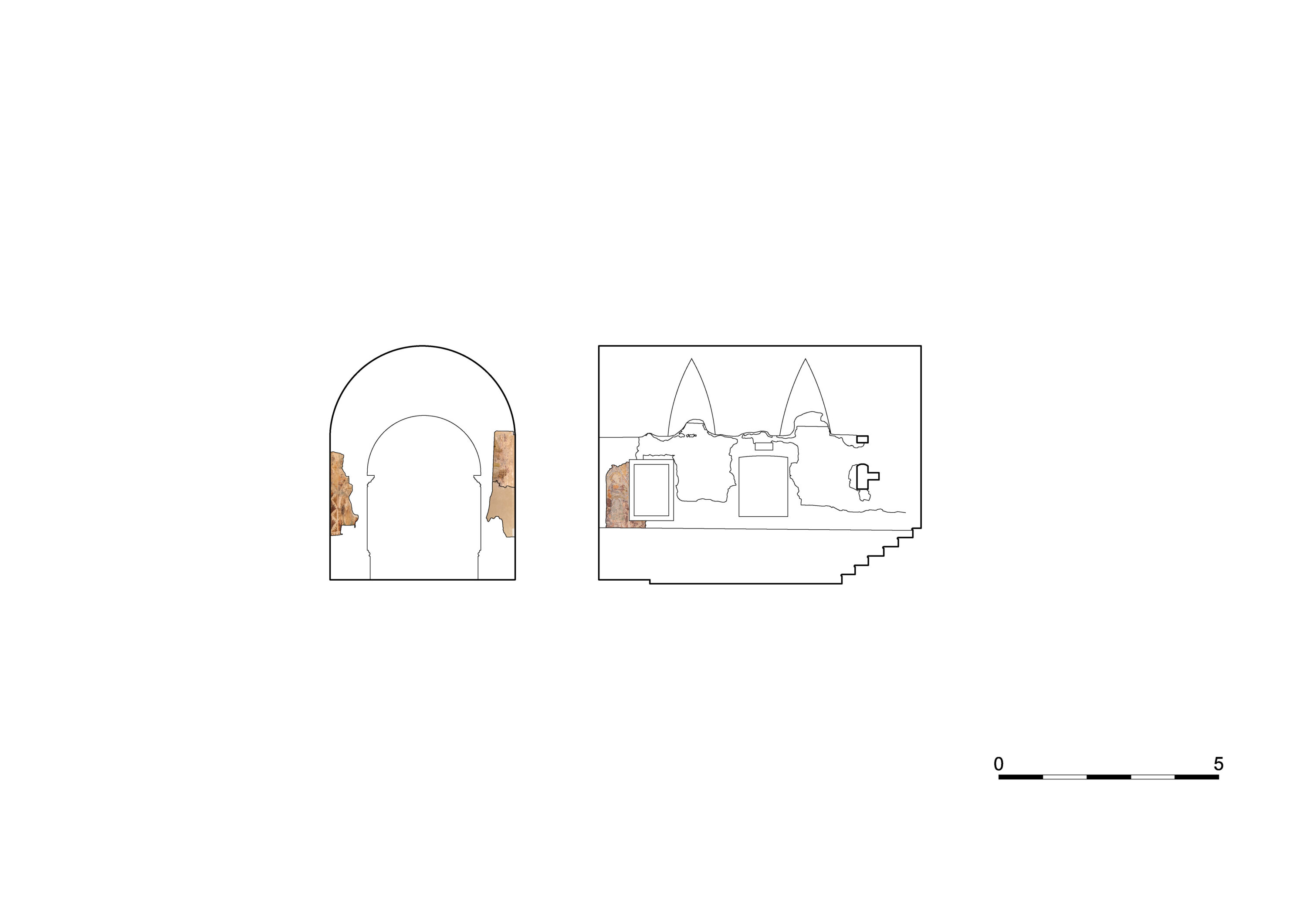

Fragments of the first layer of murals can be found on the triumphal and southern walls of the nave. The painting was probably divided into two horizontal bands. On the triumphal wall, the murals were framed by a wide bordure consisting of a zigzag of alternating branching leaves in ochre and dark red colour. The lower band featured frontally placed full-length saintly figures under trefoil-headed arcade arches with triangular pediments.
A depiction of a bishop wearing a low mitre has been partially preserved on the northern side of the triumphal wall. He is portrayed as an elderly man with shoulder-length grey hair and a short beard. His right hand is raised in blessing, while in his severely damaged left hand, he holds a book and perhaps a bishop’s staff or some other elongated attribute. He is wearing an ochre-coloured chasuble, which used to be covered in red medallions with quatrefoils in its entirety, while his undergarment is green. A fragment of drapery has been preserved in the scene above him.
On the southern side of the triumphal wall, the only preserved part of the lower band is a fragment of a saint’s head with a cap (?). The scene depicted in the upper band is more recognisable and features a partially visible kneeling figure whose right part of the body and head have not been preserved.
Only the figure on the southern wall of the nave, next to the triumphal wall, has been preserved in its entirety – at least in its basic outline. The figure stands under a triangular baldachin surrounded by columns that already show a desire for spatial design. The figure is turning to its left towards the next figure, which was almost completely destroyed when the new window opening was made: only the lower edge of the garment and a shod foot survive. The two figures are separated by a slender twisted column with a capital. The preserved standing figure holds a book on its chest with its left hand while raising its right in greeting. It is wearing a green undergarment covered in red medallions with quatrefoils, and both of its shod feet are visible from underneath the garment. A dark red cloak is wrapped over its shoulders. The badly damaged face is probably beardless and surrounded by shoulder-length brown hair.
The mural was severely damaged by the subsequent enlargement of the triumphal arch and the new window openings, while the layers of paint were additionally severely degraded by the use of lime on dry plaster and the damage made while painting the second layer of murals.
The transition from the Romanesque to the Gothic period. The frontally placed figures under the arcades and some of the patterns (especially the medallions with quatrefoils) are evidently Romanesque, while the architecture of the arcades with the trefoils is already suggestive of the Gothic period.
An unknown painter.
Due to poor preservation, none of the figures can be identified with certainty. Judging from the halos, various saints are depicted in the lower band. Janez Höfler suggested that the saint on the southern wall could be one of the apostles,[1] but this is not necessarily the case. France Stele identified the partially preserved kneeling figure on the upper band of the mural on the southern side of the triumphal wall as a portrait of the donor.[2] However, because the figure is set in a rocky landscape, Janez Höfler suggested – probably correctly – that it might be a representation of Cain’s sacrifice, as the motif of Abel and Cain’s sacrifice was common for this spot on the triumphal wall in the mural painting of the eastern Alpine region ever since the Romanesque period.[3]
________________________________________
[1] HÖFLER 2001, p. 144.
[2] This would make it one of the oldest donor portraits in Slovenia, see STELE 1969, p. 306.
[3] HÖFLER 2001, p. 144.
Pigments: white lime, yellow and red earth, green earth, carbon black
Analytical techniques: OM, SEM-EDX, FTIR
The single-layer plaster applied directly to the wall is roughly polished, of ochre-greyish tonality, and unevenly thick (10–25 mm). Apparently, it was used as an attempt to level the church’s uneven wall. Judging from the cross-sections, the lime was mixed with very fine sand of a uniform brownish colour (fig. 1). This plaster was not the base for the painting: when the unknown painter started working, it must have already been dry and set. Therefore, it does not coincide with the time of the painting. The painter used thick lime whitewash, which he applied in several layers as required. For example, he would first paint the colour of a coat, apply a layer of whitewash for a new layer of colour (an attribute, a decoration on the coat, etc.), and then paint on top of it. Ultimately, this resulted in a very thick coat of limewash, causing the mural itself to be less durable. In several places, the layers are falling off the plaster, either due to their thickness or because they are not adhering well to the base. The first research into this technique was conducted in Pangrč Grm in the middle of the 1960s by the restorer Emil Pohl,[1] who also examined a few cross-sections under a microscope and reached the following conclusion: “Under the microscope, the cross-sections reveal individual layers of limewash. Calcium carbonate crystals are concentrated on each layer, which means that the coatings were not applied immediately one after the other, but rather at shorter intervals so that the calcium hydroxide on the surface had already partially transformed into calcium carbonate before the next layer was applied. Nevertheless, all the coatings together form a uniform layer which does not exhibit a tendency to peel away. Only the separation from the base of the whitewash is noticeable. In several places, the limewash exhibits cracks that run perpendicular to the plane of its application. This damage indicates that the whitewash dried too rapidly or that the water in it evaporated too quickly, both into the dry and settled plaster below as well as into the atmosphere.”[2]
[1] POHL 1965, pp. 103–109; Ivan BOGOVČIČ, Material in tehnika gotskega stenskega slikarstva na Slovenskem, Gotika v Sloveniji/Gotik in Slowenien/Il gotico in Slovenica. Nastajanje kulturnega prostora med Alpami, Panonijo in Jadranom/Vom Werden des Kulturraums zwischen Alpen, Pannonien und Adria/La formazione dello spazio culturale tra le Alpi, la Pannonia e l’Adriatico (ed. Janez Höfler), Ljubljana 1995, p. 287.
[2] POHL 1965, p. 105.
All the pigments used by the painter are of earth origin, as also proven by the laboratory analyses of the samples taken: yellow,red, and green earth, mostly alumosilicates and iron oxides (fig. 2). The blue colour does not contain azurite but is instead a mixture of a certain organic charcoal-based black pigment mixed with white lime and red earth (fig. 1). All of the pigments contain a high amount of calcium carbonate, indicating that lime was their primary binder. The colour applications vary from glaze to impasto. The latter do not adhere to the base as well since the calcium hydroxide did not have sufficient binding power to penetrate the thicker layer. Pohl nevertheless notes that some paint layers adhere well to the base and even have a higher surface hardness than the whitewash itself. This led him to the conclusion that the painter must have mixed the pigments with a particular organic binder, probably casein, which, however, could not yet be proven in the laboratory at the time: “The presence of an organic binder is also confirmed by those paint layers where the painter achieved the final hue by repeatedly applying paint. This led to large quantities of an organic binder concentrating in the paint layer, making it harder than the base. As a result, the base would shrink differently than the layers of colour, causing the latter to start peeling away. By adding a binder, the painter achieved stronger colour shades of the impasto, and he probably used higher binder concentrations for the final corrections or retouching.”[1]
[1] POHL 1965, pp. 106–107.
The mural is painted in lime technique by painting on several layers of whitewash (figs. 1–2), which the painter added locally under almost every new coat of colour. In this manner, he bound the pigments to the base, probably by first mixing them with lime water or lime milk as well. For the thicker paint layers and the final additions, where he wanted to achieve a stronger hue, he apparently made use of another organic binder, probably casein. These final layers may have been applied dry, as indicated by some of the cross-sections (fig. 2). As the layers of whitewash are quite thick, the mural is peeling off in layers right down to the plaster.
In the case of the mural under consideration, we can discuss both at the same time. There is no sinopia in the sense of a drawing on the lower layer of plaster. Instead, it was drawn on a layer of whitewash over which new layers of whitewash, intended for colour applications, were added. Thus the drawing remained under the whitewash and, as long as the lime coating was fresh, showed through. It seems that in some cases, when the original preparatory drawing was no longer visible, the painter helped himself with additional preparatory drawings traced on the new layers of lime whitewash – for example in the case of the bishop’s attribute on the triumphal arch. He mostly used a very diluted red-brown paint, in some places also yellow, which is clearly visible in the damaged areas of the painting (fig. 3). There are no incisions, pouncing, or underpaintings. However, the painter did use local colours as a basis for subsequent modelling, most of which has fallen away.
The carnations of the faces are painted in grey, which was also the colour used for shading. The painter used this method particularly for the nose, which he did not outline with a contour, but instead drew a broad grey line thatalso functions as a shade for the sides. In the same manner, he also modelled the shades under the eyebrows and by the bridge of the nose. He shaded the cheek above the moustache with a stroke that reached the ears while shaping the mouth with an even darker shade of grey. Like the pupils, the eyes are accentuated with a black contour. The hands are mostly unpreserved: it is only possible to discern that the palms were narrow, while the fingers were long and awkwardly shaped. All we can see now is a white base and a dark red contour outlining the hands. The painter shaped the strands of hair on a grey or ochre-yellow base, on which he drew sinuous lines that have mostly fallen off. We can no longer assess how he shaped the folds of the draperies, as most of them have also peeled away. He decorated some of the garments with patterns: for example, Saint Bishop features a quatrefoil medallions pattern, probably made with a stencil because a slightly thicker layer of paint is visible at the edges of the patterns (where the brush touched the cut-out), while the saint on the southern wall has simple yellow circles arranged around his garment. Once the painter had applied the base colour, he would add more limewash for the subsequent paint layers, but always only in the size of the surface he intended to paint.
Pangrč Grm, Succursal church of St Nicholas, Stage 1 (Pangrč Grm), 2024 (last updated 29. 8. 2024). Corpus picturarum muralium medii aevi, https://corpuspicturarum.zrc-sazu.si/en/poslikava/phase-1-pangrc-grm/ (20. 9. 2026).
Legal Terms of Use
© 2026 ZRC SAZU UIFS, Corpus picturarum muralium medii aevi
ZRC SAZU
France Stele Institute of Art History
Novi trg 2
1000 Ljubljana


Spodaj seznam podrobno opisuje piškotke, ki se uporabljajo na našem spletnem mestu.
| Cookie | Type | Duration | Description |
|---|---|---|---|
| _ga | Non-Necessary | 2 years | This cookie is installed by Google Analytics. The cookie is used to calculate visitor, session, camapign data and keep track of site usage for the site's analytics report. The cookies store information anonymously and assigns a randoly generated number to identify unique visitors. |
| _gat | Non-Necessary | 1 minute | Google uses this cookie to distinguish users. |
| _gid | Non-Necessary | 1 day | This cookie is installed by Google Analytics. The cookie is used to store information of how visitors use a website and helps in creating an analytics report of how the wbsite is doing. The data collected including the number visitors, the source where they have come from, and the pages viisted in an anonymous form. |
| cookielawinfo-checkbox-necessary | Necessary | 1 year | This cookie is set by GDPR Cookie Consent plugin. The cookies is used to store the user consent for the cookies in the category "Necessary". |
| cookielawinfo-checkbox-non-necessary | Necessary | 1 year | This cookie is set by GDPR Cookie Consent plugin. The cookies is used to store the user consent for the cookies in the category "Non Necessary". |
| CookieLawInfoConsent | Necessary | 1 year | The cookie is used to store the summary of the consent given for cookie usage. It does not store any personal data. |
| PHPSESSID | session | Time of session | Cookie stores information about the user's session and allow users to keep their entries during the time of visiting the website. |
| pll_language | Necessary | 1 year | This cookie is used to remember any selection a user has made about language. |
| show_preloader_once | Necessary | Session | With this cookie we remember the user's first visit. |
| viewed_cookie_policy | Necessary | 1 year | The cookie is used to store whether or not you have consented to the use of cookies. It does not store any personal data. |
