
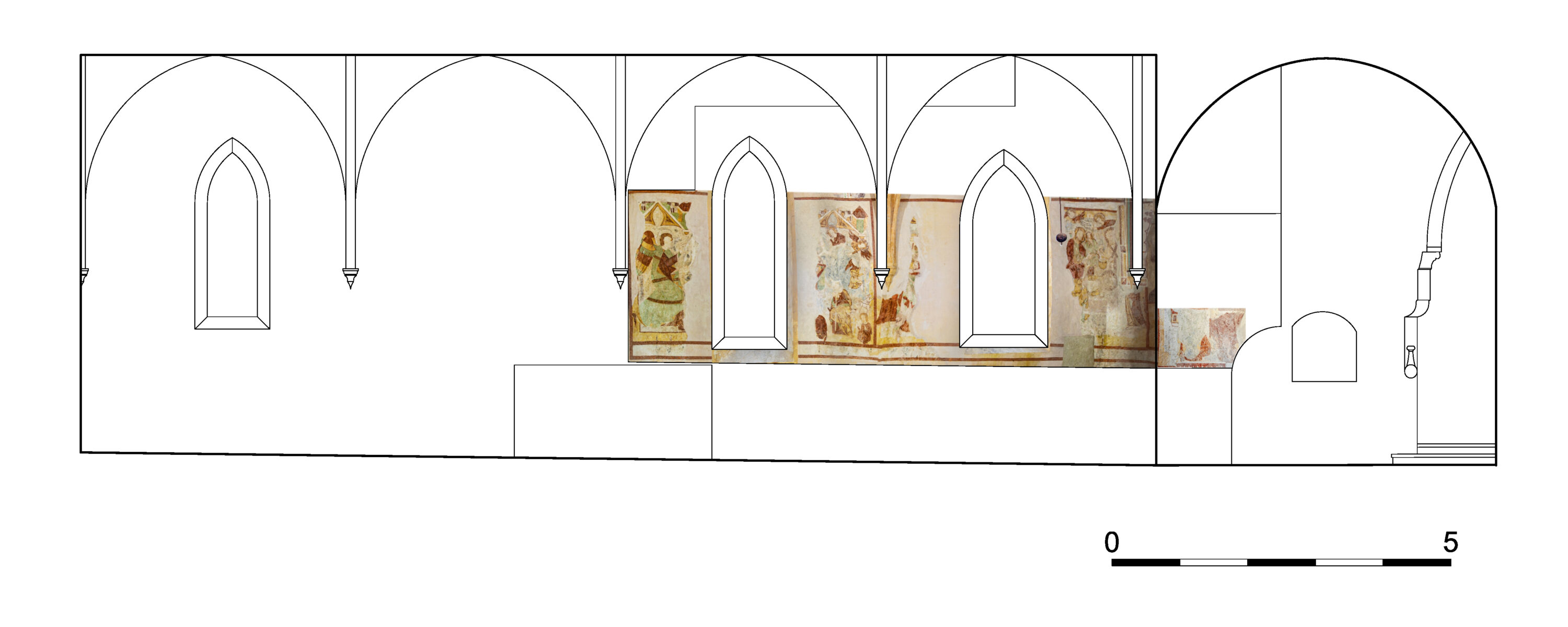

The early 14th-century cycle representing the Life of the Virgin consists of five scenes, arranged in the lower of two bands, extending across the eastern half of the northern aisle’s northern wall and onto its eastern wall. The cycle proceeds from the west to the east, starting with the Annunciation motif,[1] followed by the Nativity with the annunciation to the shepherds and the almost completely destroyed Procession of the Magi and the Death of Mary scenes, while the Coronation of Mary scene is already depicted on the eastern wall.[2]
The Marian cycle therefore begins with the Annunciation scene. The only preserved figure is the angel depicted wearing a long robe, walking lightly and facing right.[3] His leg is painted in such a manner as to cross the frame.[4] He holds an inscription band in his left hand while his right arm is slightly raised.[5] The details on his face have not been preserved, as they fell off when the limewash was removed.[6] The angel’s wings stand out, as they are divided into three-coloured bands and shaped remarkably plastically at the top.[7] Three decorative bands, painted at the level of the angel’s chest, hip, and knees, are arranged over the angel’s upper garment, which is fastened below his neck with a buckle.[8] Above the figure of the angel, the composition is topped by a lance-shaped ornamented arch with a flatly designed architectural element with two small towers (?),[9] which France Stele referred to as a baldachin.[10]
The cycle continues with the Nativity and the annunciation to the shepherds. Only the right half of the image with Joseph, two shepherds, two angels, and a remnant of Mary’s garment remains.[11] Joseph sits in the centre of the otherwise fragmentarily preserved composition,[12] leaning on his shepherd’s staff with both hands. His head is bent forward, and he is wearing a pointed Jewish headdress.[13] His hair is painted in lush curls resembling volutes.[14] The two shepherds are painted on the right side of the composition. The shepherd in the viewer’s lower right corner stands out for his christomorphic features and design.[15] He is painted in a seated pose, with his knees drawn up and his arms raised, slightly bent at the elbows. While this shepherd is static, the other one is portrayed in a more animated pose. He is painted in profile, in the middle of a stride and with his arms slightly raised. He is most easily recognised by his elongated red-brown hood.[16] The scene is topped by two waist-up depictions of angels with inscription bands.[17] The right angel announces the birth of Jesus to the shepherd, while the left angel worships the Child, as indicated by the fragment of the manger with the ox and the donkey, pointed out by Tanja Zimmermann.[18] The composition also includes a pair of goats, enlivening the scene.[19] Here, the upper part of the composition is once again completed by a pointed arch, in this case adorned with buds.[20]
The next scene of the cycle has been largely destroyed. It used to depict the Procession of the Magi, and the long two-piece garment of the first king is still visible on the left.[21]
The last scene on the northern wall was dedicated to the Virgin Mary’s death. It is still possible to discern the upper part of Mary’s reclining body on the bed, behind which the figure of Christ on the viewer’s left holds up, in both hands, an image of a little crowned girl, representing Mary’s soul.[22] With her arms raised, Mary is in the pose of an orant. She has a ribbon in her hair that also reaches over her forehead.[23] A male figure, identified as St Peter, stands on the viewer’s right with ribbons crossed on his chest and a stoup in his hand.[24] Two angels with inscription bands are painted at the top of the composition. According to Lev Menaše, the angel above Christ, painted on the left, carries a palm branch.[25]
The cycle’s final scene was painted on the triumphal arch wall and probably depicted the Coronation of Mary. The only preserved parts of this scene include the lower section of the garment of the female figure, portrayed in the frontal pose, and a ray halo, deeply incised in the centre of the figure of Mary in the Crucifixion scene above.[26] In 1936, Janez Veider wrote that the lower part of the scene was visible, portraying the seated Mary and Jesus down to their knees.[27] Tanja Zimmermann wrote something similar, adding that a fragment of the architecture of the throne with a bifora was also visible.[28]
The upper parts of some scenes from this cycle, such as the Annunciation and the Nativity, are concluded with an architectural trefoil decoration, while others, such as the Death of Mary, are merely outlined with a simple single-colour bordure.[29]
________________________________________
[1] STELE 1935, p. 41; VEIDER 1936, p. 6; STELE 1938, p. 95; STELE 1962, p. 17; STELE 1972, p. 52; MENAŠE 1994, p. 286; ZIMMERMANN 1995b, p. 228; HÖFLER 1996, p. 87; ZIMMERMANN 1996, p. 58; KOMAN 2000, p. 29; KRIŽNAR 2006, pp. 138–139.
[2] STELE 1935, p. 41; VEIDER 1936, pp. 6–7; STELE 1938, p. 95; STELE 1962, pp. 17–18; STELE 1972, p. 52; MENAŠE 1994, p. 286; ZIMMERMANN 1995b, p. 228; HÖFLER 1996, p. 87; ZIMMERMANN 1996, p. 58; KOMAN 2000, p. 29; KRIŽNAR 2006, pp. 138–139. The Crucifixion scene, variously dated in the relevant literature, is also visible above the Coronation of Mary motif. For more information about this, see the section on the first stage of the mural.
[3] HÖFLER 1996, p. 87.
[4] ZIMMERMANN 1995b, p. 228.
[5] STELE 1962, p. 17.
[6] STELE 1962, p. 17.
[7] ZIMMERMANN 1995b, p. 228.
[8] ZIMMERMANN 1995b, p. 228.
[9] Cf. ZIMMERMANN 1995b, p. 228.
[10] STELE 1962, p. 17.
[11] ZIMMERMANN 1995b, p. 229.
[12] ZIMMERMANN 1995b, p. 229.
[13] ZIMMERMANN 1995b, p. 229.
[14] ZIMMERMANN 1995b, p. 229.
[15] ZIMMERMANN 1995b, p. 229; ZIMMERMANN 1996, p. 59.
[16] ZIMMERMANN 1995b, p. 229.
[17] ZIMMERMANN 1995b, p. 229.
[18] ZIMMERMANN 1995b, p. 229; ZIMMERMANN 1996, p. 58.
[19] HÖFLER 1996, p. 87. VEIDER 1936, p. 6, identified the depicted animals as sheep.
[20] ZIMMERMANN 1995b, p. 229.
[21] HÖFLER 1996, p. 87.
[22] HÖFLER 1996, p. 87.
[23] MENAŠE 1994, p. 265; ZIMMERMANN 1996, p. 59.
[24] HÖFLER 1996, p. 87. ZIMMERMANN 1996, p. 59, states that two apostles are portrayed and that only the upper part and face of the first and the lower part of the body and the truncated foot of the second have been preserved.
[25] MENAŠE 1994, p. 266.
[26] HÖFLER 1996, p. 88.
[27] VEIDER 1936, p. 6.
[28] ZIMMERMANN 1996, p. 60.
[29] ZIMMERMANN 1996, p. 59, 153. VEIDER 1936, p. 7, stated that all the scenes from Mary’s life were placed in painted arcades with tracery, turrets, and roofs, although the Death of Mary scene is not really depicted in such a frame.
The mural, characterised by early Gothic typified faces, a red-brown drawing with individual more colourful parts, and flat-looking garments, belongs to the High Gothic linear style.[1] The angel in the Annunciation scene and Christ in the Death of Mary scene have ray halos incised deep into the plaster, while Mary and St Peter in the Death of Mary scene feature halos whose interior is outlined by small arches.[2] The mural was painted using the al fresco technique, i.e. on fresh plaster, while the colour modelling was completed using the dry technique.[3]
Due to the stylistic similarity to the murals in Bohinj, Vrzdenec and Sv. Tomaž above Praprotno[4] and based mainly on the fashion details or the figures’ garments, Tanja Zimmermann moved the dating of the cycle slightly deeper into the 14th century.[5] The murals at all these locations share the colour palette consisting of green, ochre, and brown-red colours, as well as strong contours and conservative stylistic features.[6] The oldest layer on the northern interior wall of the Bohinj church is particularly similar.[7] The parallels are already evident from the facial types, with the faces of the Crngrob angels resembling the face of St John the Evangelist from the poisoning scene in Bohinj, while the face of Aristodemus from the same scene is stylistically close to the modelling of Joseph’s face in the Crngrob Nativity scene.[8] Certain stylistic parallels with the Crngrob mural are also evident from the modelling of the folds on the garment of the saint portrayed on the southern side of the triumphal arch wall of the Sv. Tomaž above Praprotno church,[9] where the deep bowl-shaped folds at the saint’s knees and the way the fabric is shaped at his feet are similar to the garments of the apostle in the Death of Mary scene in Crngrob.[10]
According to Tanja Zimmermann’s assessment, the style of the artist who painted the Crngrob Marian cycle was influenced by the painting in the Lake Constance area.[11] She referred to the Passion Cycle in St Leonard’s Chapel in Landschlacht on Lake Constance as an example of similar stylistic foundations.[12] She compared the rhythm and monumentality of the angel in the Crngrob Annunciation to the late 13th-century painting in the Zur Kunkel house in Konstanz and the positioning under the architecture and the manner in which the draperies were depicted to a mural painted shortly after the year 1300 on the western wall of the Dominican church in Konstanz.[13] In the style of the Crngrob painter, she also recognised the features of Carinthian art of the second quarter of the 14th century, characterised by the figures’ strong gesticulation and imprecise drawing.[14]
________________________________________
[1] HÖFLER 1996, p. 87; KOMAN 2000, p. 20; KRIŽNAR 2006, p. 139.
[2] HÖFLER 1996, p. 87.
[3] KRIŽNAR 2006, p. 140.
[4] We are referring to the murals in the succursal church of St John the Baptist by Lake Bohinj, the succursal church of St Cantianus in Vrzdenec, and the succursal church of Sv. Tomaž above Praprotno. Already France Stele noticed the similarities between the Crngrob Marian cycle and the Vrzdenec mural. Regarding the Crngrob mural, he thus wrote that it was “related in many respects to the one in Vrzdenec”, cf. STELE 1935, p. 41; STELE 1938, p. 95.
[5] ZIMMERMANN 1996, p. 57; HÖFLER 1996, p. 10.
[6] ZIMMERMANN 1996, p. 57; HÖFLER 1996, p. 10.
[7] ZIMMERMANN 1995b, p. 229; ZIMMERMANN 1996, p. 62.
[8] ZIMMERMANN 1996, pp. 58–59, 62.
[9] ZIMMERMANN 1996, p. 62.
[10] ZIMMERMANN 1996, p. 62.
[11] ZIMMERMANN 1996, p. 60.
[12] ZIMMERMANN 1996, p. 60.
[13] ZIMMERMANN 1996, p. 58.
[14] ZIMMERMANN 1996, p. 61.
The origin of the Marian cycle has been dated to the first quarter of the 14th century. Janez Veider, France Stele, and Emilijan Cevc assume it was painted around 1300;[1] Janez Höfler dates its creation to around 1300–1320;[2] while Tanja Zimmermann places it between 1320 and 1330.[3] Dušan Koman gave a less restrictive dating and placed the cycle in the first decades of the 14th century.[4]
________________________________________
[1] VEIDER 1936, p. 5; STELE 1962, p. 17; CEVC 1966, p. 52. France Stele also places the origin of the mural in the early 14th century; see STELE 1938, p. 95; STELE 1972, p. 52.
[2] HÖFLER 1996, p. 87.
[3] ZIMMERMANN 1996, pp. 57, 198.
[4] KOMAN 2000, p. 20.
The Crngrob cycle representing the Life of the Virgin, dating from the beginning of the 14th century, was painted by the master who was also involved in the creation of the oldest layer on the nave’s northern wall in the church of St John the Baptist by Lake Bohinj.[1] A workshop formed around this master and was active in the period between approximately 1300 and 1320.[2] The same workshop also painted the churches in Vrzdenec and Sv. Tomaž above Praprotno.[3]
________________________________________
[1] HÖFLER 1996, p. 10; ZIMMERMANN 1996, p. 57.
[2] HÖFLER 1996, p. 10.
[3] HÖFLER 1996, p. 10.
The scenes from the life of Mary in Crngrob are considered to represent the oldest cycle dedicated to Mary in the Slovenian territory.[1] Compared to the more recent depictions, the Crngrob cycle is somewhat less extensive, as it is an abbreviated version, common for the 14th century.[2] It consists of a total of five basic scenes, considered to be the most crucial events in the Virgin’s life.[3] The Death of Mary and the Coronation of Mary scenes stand out. The Death of Mary scene is a depiction of a Byzantine type.[4] The dying Virgin is painted on a bed with the apostles standing behind it – as a rule, all twelve of them, including Christ who receives Mary’s soul in the form of a child.[5] Forerunners of the Crngrob depiction can be found in various Northern European illuminated manuscripts.[6] Lev Menaše mentions that the angel above Christ is holding a palm branch, which could herald Mary’s death. However, the author believes it is more plausible that the branch in this scene can be interpreted as a symbol of victory over death.[7] In relation to the Coronation of Mary scene, however, Janez Höfler assumes that, in case it was indeed depicted here, the painter was drawing on the pre-Italian or pre-French iconographic models where the Virgin Mary is portrayed standing.[8]
________________________________________
[1] MENAŠE 1994, p. 285.
[2] ZIMMERMANNN 1996, p. 57.
[3] MENAŠE 1994, p. 286.
[4] MENAŠE 1994, p. 265.
[5] STELE 1969, p. 256.
[6] MENAŠE 1994, p. 266.
[7] MENAŠE 1994, p. 266.
[8] HÖFLER 1996, p. 88.
Pigments: slaked lime, yellow and red earth, green earth, mixed blue, carbon black
Analytical techniques: OM, SEM-EDX, FTIR
The mural was probably painted on a single layer of plaster, which is very hard and durable. In the absence of any plaster samples, it is impossible to precisely determine its composition.
The yellow, red, and red-brown pigments are of earth origin – alumosilicates (Al, Si) and iron oxides (Fe). For the green colour, green earth was used, which contained the characteristic chemical elements (Ca, Fe, Si, K, Mg, Al). Already visually, the blue colour is not very strong, while the results of the analyses only revealed the presence of elements indicating a mixture of white (slaked lime), black (charcoal), and red (red ochre). The artist painted with the blue directly on the plaster, and in some places, it appears that he applied the colour in two layers – a light base blue and a darker top layer – as some parts have retained slightly darker patches that do not adhere well to the underlying painting base. This could be due to the possible discolouration of the blue colour, which is not uncommon, or it could also be because of dirt, which tends to mix very readily with the porous layers of some colours. The presence of sulphur in some places indicates that the surface of the murals has been subject to sulphatisation. The considerable calcium content in the colour layers confirms that lime was the main binder, both from the plaster and as added lime water or lime milk. For the modelling and the final details, the painter must have also coated the pigments with an organic binder, which, however, could not be identified.
The mural is an example of the al fresco technique, which the painter used to execute everything from the underdrawing to the larger colour surfaces. He probably painted on larger intonaco surfaces that started drying before the works were completed. The colour modelling was therefore finished al secco, and the painter added an organic binder to the pigments to make them adhere better to the painting base.
Consistent with the early date of the mural, there is no sinopia. For the underdrawing, the painter used black colour, which can be seen mainly on the faces (fig. 2). In certain areas, a stronger reddish-brown line is visible, but it may have been used to create the final contours, painted over the black underdrawing. Perhaps, however, the combination of both colours may have already been applied during the underdrawing stage, as in some places, there is no trace of the black drawing – for example, the hands of the angel in the Annunciation scene are outlined in red-black as the initial drawing on fresh plaster (fig. 3). Unlike the Crucifixion scene, the Virgin Mary cycle features deep incisions cut into the fresh plaster layer. These were used for the halos (the angel – figs. 3–4, Christ), adorned with ray-shaped pouncings. The bordures were also incised using thin lines, which, however, are barely visible, as the painter delimited the bordures by drawing a colour line over them. Regarding this mural, we can also speak mainly of local tones (rather than underpaintings), especially in yellow, green, and red. All colours of the larger surfaces were applied with a broad brush on fresh plaster, as they are exceedingly durable.
The modelling on the base colour layers has almost completely fallen off or faded. The painter had to complete the cycle al secco, as in some places, we can still see the remnants of colours that attest to this method. The painter applied the colours from light to dark, but there were probably no soft colour transitions. The modelling of the faces and hands has not been preserved. However, in some places, it is still possible to discern long noses with prominent nostrils, high semicircular eyebrows, and beautifully shaped large eyes with a semicircular upper and a flat lower line. The hair and beards are modelled on the basic local tones with simple, sinuous lines, conveying the impression of curls. The modelling of the draperies was probably executed al secco by applying slightly darker tones to the base. These colour layers have mostly fallen off, but traces of them can still be seen in some places. The painter drew the folds with single brushstrokes and finally applied a light glaze, which can still be detected sporadically. The architecture is painted flat, without any spatial effects. Interestingly, the yellow colour of the tracery does not precisely follow the contour frame (fig. 4). It does not appear that any stencils were used.
Crngrob, Succursal church of the Annunciation, Stage 2 (Crngrob), 2024 (last updated 2. 9. 2024). Corpus picturarum muralium medii aevi, https://corpuspicturarum.zrc-sazu.si/en/poslikava/phase-2-crngrob/ (19. 1. 2026).
Legal Terms of Use
© 2026 ZRC SAZU UIFS, Corpus picturarum muralium medii aevi
ZRC SAZU
France Stele Institute of Art History
Novi trg 2
1000 Ljubljana


Spodaj seznam podrobno opisuje piškotke, ki se uporabljajo na našem spletnem mestu.
| Cookie | Type | Duration | Description |
|---|---|---|---|
| _ga | Non-Necessary | 2 years | This cookie is installed by Google Analytics. The cookie is used to calculate visitor, session, camapign data and keep track of site usage for the site's analytics report. The cookies store information anonymously and assigns a randoly generated number to identify unique visitors. |
| _gat | Non-Necessary | 1 minute | Google uses this cookie to distinguish users. |
| _gid | Non-Necessary | 1 day | This cookie is installed by Google Analytics. The cookie is used to store information of how visitors use a website and helps in creating an analytics report of how the wbsite is doing. The data collected including the number visitors, the source where they have come from, and the pages viisted in an anonymous form. |
| cookielawinfo-checkbox-necessary | Necessary | 1 year | This cookie is set by GDPR Cookie Consent plugin. The cookies is used to store the user consent for the cookies in the category "Necessary". |
| cookielawinfo-checkbox-non-necessary | Necessary | 1 year | This cookie is set by GDPR Cookie Consent plugin. The cookies is used to store the user consent for the cookies in the category "Non Necessary". |
| CookieLawInfoConsent | Necessary | 1 year | The cookie is used to store the summary of the consent given for cookie usage. It does not store any personal data. |
| PHPSESSID | session | Time of session | Cookie stores information about the user's session and allow users to keep their entries during the time of visiting the website. |
| pll_language | Necessary | 1 year | This cookie is used to remember any selection a user has made about language. |
| show_preloader_once | Necessary | Session | With this cookie we remember the user's first visit. |
| viewed_cookie_policy | Necessary | 1 year | The cookie is used to store whether or not you have consented to the use of cookies. It does not store any personal data. |
