
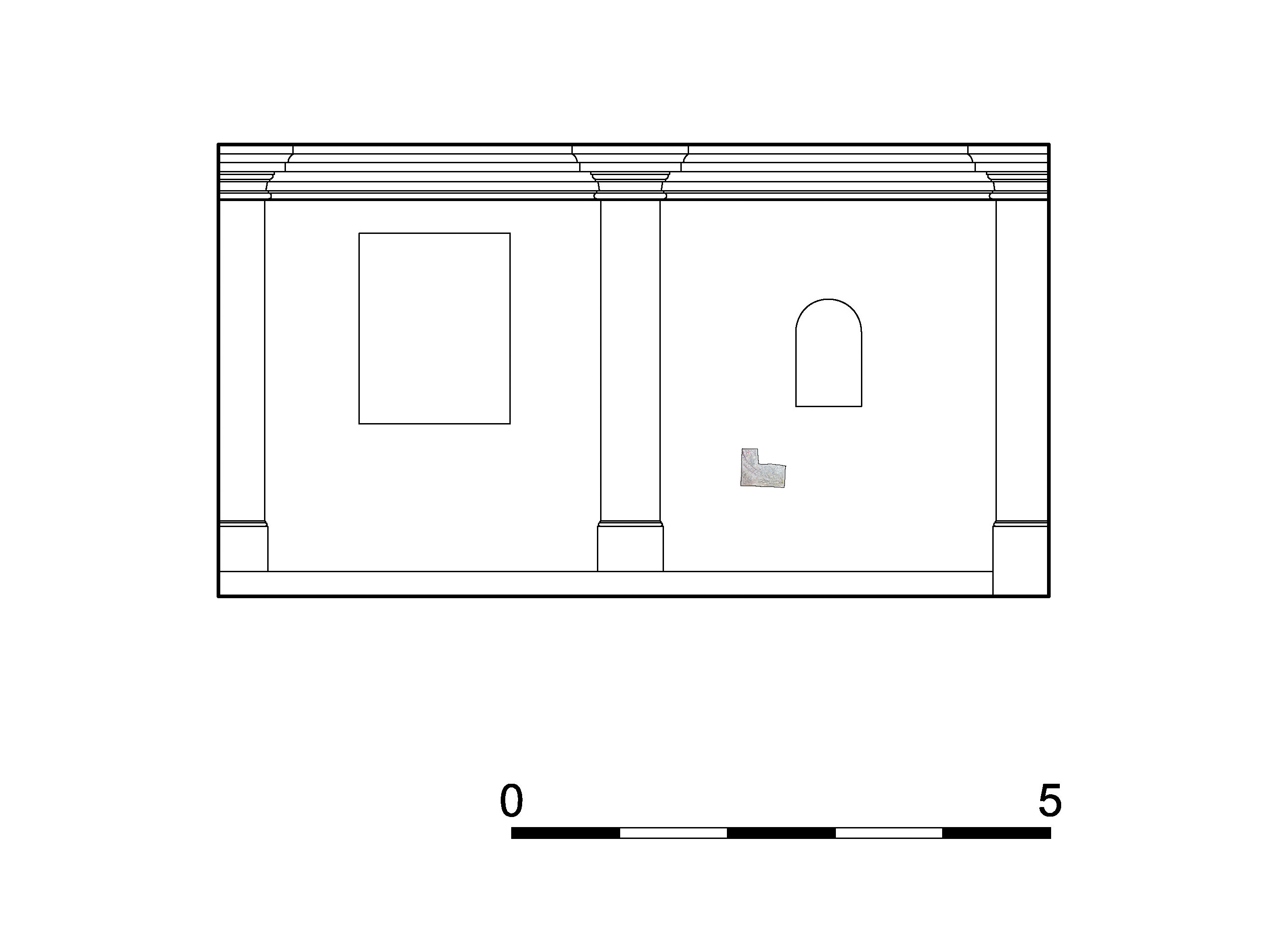

Nave, northern and southern wall, fragments
Pigments: white lime, red earth
Analytical techniques: OM, XRF, XRD
Chancel, southern wall, fragment
Pigments: white lime, yellow ochre
Analytical techniques: OM, XRF, XRD
Nave, northern and southern wall, fragments
The plaster is rough and very hard; perhaps it was consolidated during restoration. The fact that limewash was applied over it has been confirmed by the cross-sections of the samples taken (Figs. 1–2). The plaster appears bright, mostly containing angular, translucent aggregate grains (Fig. 2), though it also includes some dark sand grains (Fig. 1). The plaster samples from the northern and southern walls have been analysed using the XRD technique to determine whether the two fragments belong to the same mural. Both samples show the presence of quartz, calcite, and dolomite, as well as some feldspars. The sample from the northern wall mostly consists of quartz as the aggregate, while the binder content is somewhat more modest. Both calcite and dolomite can be used as binders, and both can also be crushed into the aggregate (translucent grains). The northern wall sample contains more dolomite than calcite. In contrast, the sample from the southern wall contains remarkably little quartz but an abundance of calcite and dolomite, of which the latter is once again prevalent. Based on the XRD analysis, it appears that the plaster on the southern wall differs from the one on the northern wall, suggesting that the fragments belong to two separate murals. Regardless of the relative amounts of the plaster ingredients, we should underline that they are identical in both samples and especially that the proportion between the calcite and dolomite is similar. In medieval mural plasters, dolomite was relatively rare compared to calcite. Thus, despite the differences in the quantity of the ingredients on the two walls, this could nevertheless be a single mural, which could be confirmed by further analyses. On the other hand, the murals may also be two separate works, but the materials could have been obtained from the same location.
Chancel, southern wall, fragment
In the chancel, limewash was also applied to the rough plaster. The cross-section only reveals the limewash, which has fallen off, and a yellow colour layer (Fig. 3). The XRD analysis of the sample reveals an extremely high content of dolomite, much less calcite, and an extraordinarily low quartz content. Feldspars are also present. The plaster is therefore made of lime (calcite and/or dolomite) and crushed dolomite or marble with a bit of quartz. The ingredients are identical to the mural fragments on the two nave walls, but the proportions are notably different from the samples taken in the nave. Due to its modest quartz content, the analysed sample is more similar to the sample from the southern nave wall. We should underline the significant presence of dolomite, which is also present in the nave, as a rarer medieval plaster ingredient in the territory of today’s Slovenia. Based on the results, it is impossible to either confirm or deny that the mural in the chancel was painted at the same time as the ones in the nave. It is possible that the nave and the chancel were painted simultaneously, or the murals might originate from different periods while the materials could have been sourced from the same place. It would be interesting to investigate the potential nearby dolomitic rock deposits.
Nave, northern and southern wall, fragments
The colour palette is limited, as only pink and red remain visible. The XRF analysis identified the red colour as red earth (iron), while the pink is a mixture of white lime (calcium) and a bit of red eearth. The analysis has also revealed modest lead content in the red colour, indicating the use of some lead pigment. However, rather than being a part of the painter’s original colour palette, the lead probably stems from the subsequent retouching, carried out before the 20th century, when lead pigments were abandoned because of their toxicity.
Chancel, southern wall, fragment
The yellow pigment is yellow ochre (Fig. 3), applied to the limewash or white lime, as indicated by the XRF analysis based on the high iron and calcium content. The red centre line was painted using red earth (iron). The binder is lime from the limewash, while the pigment may also have been impregnated with lime water or lime milk. The cross-section reveals that the lime passes into the colour layer, indicating that the yellow colour was applied to a fresh base.
Nave, northern and southern wall, fragments
The presence of limewash in all the samples suggests the lime technique (Figs. 1–2). The colours were applied directly to the limewash.
Chancel, southern wall, fragment
The mural was painted using the lime technique, which can be determined based on the limewash.
Nave, northern and southern wall, fragments
The circle was incised with deep and broad incisions. There are no incisions on the southern wall. Perhaps the underdrawing was painted in a lighter red, visible from underneath the darker colour. However, since it was applied on a pink background, it may have simply been used for colour modelling and to combine two different shades of red. The painter only used broad brushes and applied the colours with decisive strokes.
Chancel, southern wall, fragment
The fragment probably features a visible yellow underdrawing, painted with firm strokes of a brush about a centimetre thick. The painter dipped the brush into the colour several times, as in some places, where he refreshed the brush with new paint, a darker shade of ochre is visible, after which the stroke gets lighter. He sometimes repeated the strokes or slightly corrected the painted lines. It is still possible to discern a thin, straight red line in the centre of the fragment, apparently made with a string dipped in red paint and stamped on the wall.
Žiganja vas, Succursal church of St Ulrich, Stage 1 (Žiganja vas), 2024 (last updated 12. 12. 2024). Corpus picturarum muralium medii aevi, https://corpuspicturarum.zrc-sazu.si/en/poslikava/phase-1-ziganja-vas/ (23. 9. 2026).
Legal Terms of Use
© 2026 ZRC SAZU UIFS, Corpus picturarum muralium medii aevi
ZRC SAZU
France Stele Institute of Art History
Novi trg 2
1000 Ljubljana


Spodaj seznam podrobno opisuje piškotke, ki se uporabljajo na našem spletnem mestu.
| Cookie | Type | Duration | Description |
|---|---|---|---|
| _ga | Non-Necessary | 2 years | This cookie is installed by Google Analytics. The cookie is used to calculate visitor, session, camapign data and keep track of site usage for the site's analytics report. The cookies store information anonymously and assigns a randoly generated number to identify unique visitors. |
| _gat | Non-Necessary | 1 minute | Google uses this cookie to distinguish users. |
| _gid | Non-Necessary | 1 day | This cookie is installed by Google Analytics. The cookie is used to store information of how visitors use a website and helps in creating an analytics report of how the wbsite is doing. The data collected including the number visitors, the source where they have come from, and the pages viisted in an anonymous form. |
| cookielawinfo-checkbox-necessary | Necessary | 1 year | This cookie is set by GDPR Cookie Consent plugin. The cookies is used to store the user consent for the cookies in the category "Necessary". |
| cookielawinfo-checkbox-non-necessary | Necessary | 1 year | This cookie is set by GDPR Cookie Consent plugin. The cookies is used to store the user consent for the cookies in the category "Non Necessary". |
| CookieLawInfoConsent | Necessary | 1 year | The cookie is used to store the summary of the consent given for cookie usage. It does not store any personal data. |
| PHPSESSID | session | Time of session | Cookie stores information about the user's session and allow users to keep their entries during the time of visiting the website. |
| pll_language | Necessary | 1 year | This cookie is used to remember any selection a user has made about language. |
| show_preloader_once | Necessary | Session | With this cookie we remember the user's first visit. |
| viewed_cookie_policy | Necessary | 1 year | The cookie is used to store whether or not you have consented to the use of cookies. It does not store any personal data. |
