

Interior, the nave triumphal arch, southern side: St Erasmus
Pigments: white lime (calcite), yellow earth, red earth (haematite), cinnabar, malachite (?), carbon black
Analytical techniques: OM, Raman, XRD
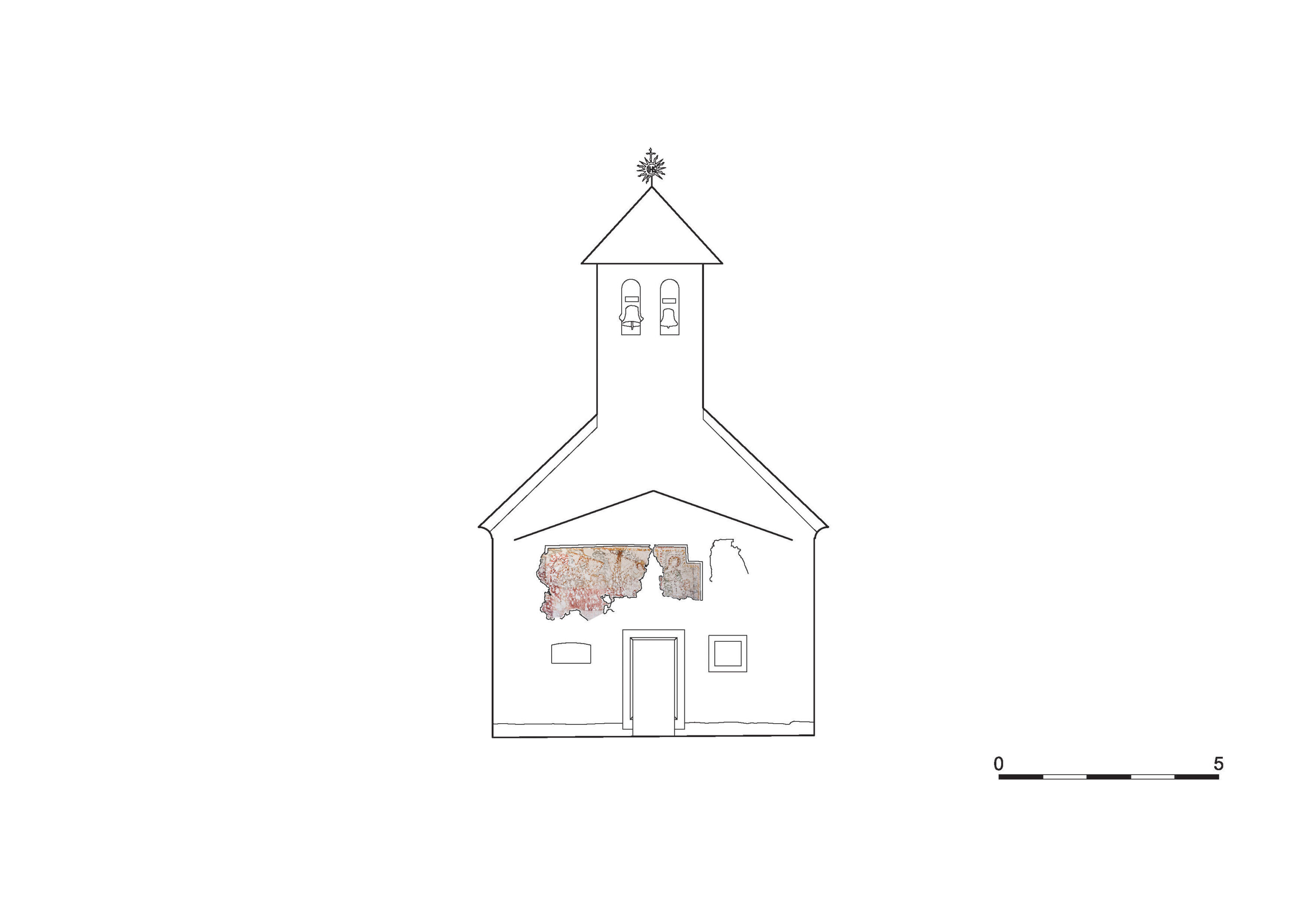
Exterior, the western façade: Navicella and the female saint with a donor/votive image
Pigments: white lime (calcite), yellow earth (goethite), red earth (haematite), green earth, carbon black
Analytical techniques: OM, Raman, XRD
Interior, the nave triumphal arch, southern side: St Erasmus
To the naked eye, the plaster used for the painting base for the image of St Erasmus appears very white and of good quality. It is quite hard and compact. The cross-sections also reveal a white base (Fig. 1). Chemical analyses using the Raman technique indicated calcite, dolomite, and quartz content, while an X-ray analysis revealed a high dolomite content and less calcite. There are no impurities in the plaster. We can confirm the use of a very high-quality plaster made with a light, translucent aggregate, crushed dolomite, or perhaps dolomitic marble. The upper layer of plaster, which completes the scene with St Erasmus in some places, is of a slightly different composition. Also in this case, X-ray diffraction identified only dolomite and calcite. However, this plaster contains even less calcite, i.e. the lime binder, which makes it more crumbly. It is also extremely thin (about 3 millimetres). The work in question is probably a subsequent repainting or perhaps a refinement of the saintly figure, using the same material but different proportions. There are no discernible giornate.
Exterior, the western façade: Navicella and the female saint with a donor/votive image
There are probably two layers of plaster: the lower layer is coarser, while the upper one is finer, brighter, and consists of lime and crushed limestone and/or quartz sand (Fig. 4). In the cross-sections, only the top layer is visible, which is very bright and contains barely visible aggregate grains. The plaster here is very similar to the one under the image of St Erasmus on the nave side of the triumphal arch in the interior. X-ray diffraction analyses confirmed the same composition, with a high dolomite content and less calcite (Fig. 5). The aggregate is therefore crushed dolomite or dolomitic marble, while the binder is lime. The identical composition of the plaster suggests that the same painting workshop was commissioned for both murals, i.e. the ones on the southern side of the nave triumphal arch and the western façade.
Interior, the nave triumphal arch, southern side: St Erasmus
The painter used white lime, yellow earth, and red earth (haematite). The analyses also revealed some cinnabar on the outer red border of Erasmus’s cloak. The cool hue of the colour layer and the shape and colour of the particles in the cross-sections suggest that the green pigment may be malachite, although the analyses did not yield a definitive result (Fig. 1). In some places, either the green pigment or the wrinkles painted on it subsequently have darkened. The sample taken from one of the black stains on the green cape shows a dense brown layer. However, only kaolinite was identified using Raman analysis, suggesting an iron oxide pigment (Fig. 2a–2b). Red colour is used in both lighter and darker – almost black – hues. The painter also had carbon black in his palette, which he mixed with white lime to make grey. The binder is mostly lime from the plaster, though he also coated the pigments with some organic binder for the final details and modelling, which have mostly fallen off.
Exterior, the western façade: Navicella and the female saint with a donor/votive image
The pigments used were mainly yellow and red earth (goethite and haematite) as well as white lime. The green colour was obtained with a blend of green soil and a bit of yellow ochre (Fig. 5). The blue colour is most probably a mixture of white lime, some organic black, and a little red earth – unless the blue azurite has fallen off the cross-section and all that remains is a layer of grey underpainting. The black pigment is carbon black. The binder is lime from the plaster, though some organic binder was probably also used for the final modelling and contours.
Interior, the nave triumphal arch, southern side: St Erasmus
The good preservation of the painted surfaces suggests al fresco painting, while some of the modelling and the final details and contours were most likely painted dry. The lime technique may also have been used in some places, as indicated by a few of the samples (Figs. 1–2).
Exterior, the western façade: Navicella and the female saint with a donor/votive image
Despite extensive damage, the colour layers are still relatively well preserved, indicating al fresco painting. This is also confirmed by the cross-sections, although it appears that the plaster was already drying when the colour layers were applied, as the line between it and the colour layers is quite well defined. In several places, the colour surfaces have peeled off, indicating the use of a dry technique to complete the painting.
Interior, the nave triumphal arch, southern side: St Erasmus
Numerous deep and wide incisions were used: for the halo decorated with ray-shaped pouncings (perhaps originally gilded), the mitre and the outline of Erasmus’s head, the collar of the headdress, and for the decorative cross-formed belt running down his body. The latter was also decorated with applications: semi-precious stones or coloured glass were probably used, but these have all been lost, leaving only recesses in the plaster. The bishop’s staff and the ribbon hanging from Erasmus’s left hand were also incised. Further incisions are also noticeable in the architectural elements. Judging from the number of incisions, the underdrawing was limited to the figure exclusively. We cannot see it clearly anywhere: perhaps the painter painted it in yellow, which he also used for much of the modelling. On the other hand, one of the samples (Fig. 2) suggests a possible black underdrawing. The painter was well-versed in creating light and shades as well as the transitions between them, which he achieved with a combination of broad and thin brushes. Much of the basic colour layers on Erasmus’s face have been preserved, mostly in ochre shades, with some redness on the right cheek (Fig. 3). His head is elongated, while his eyes are large and almond-shaped with a prominent dark brown upper eyelid margin and narrow under-eye bags. Above the eyes are slightly arched long eyebrows, under which the painter applied shading with a darker ochre colour, which is very characteristic of him: otherwise, such a feature is not often seen in other painters. The irises are yellow: the final colour (blue?) may have fallen off. The nose is straight and long, protruding from the inner eyebrow, but it is impossible to see how it concluded because of the damage. The mouth has not been preserved, as this part of the mural is also damaged. Erasmus’s head is adorned with a neatly shaped hairdo with curls in the middle of the forehead and below the ears, shaped in the same way as his beard and moustache – i.e., with lighter and darker ochre strands. His figure is exaggeratedly long yet slender and elegant, clad in a green coat and an ochre tunic. The painter modelled the latter with broader and thinner brushes, which he used to apply shades of various intensities, the darker ones being deeper in the folds. The modelling of the coat has not been preserved. The artist in question was a skilful painter who was even able to incorporate optical perspective into the architectural elements.
Exterior, the western façade: Navicella and the female saint with a donor/votive image
The painter used a double parallel line to incise the edge of the circular halos, and thin incisions are also discernible on the sail in the Navicella (Jesus walks on the water) scene. The figures were outlined with a red underdrawing, which is clearly visible because the entire colour layer or at least the modelling has fallen off in several places, especially on the faces. The underdrawing was made with a firm stroke and a line approximately five millimetres wide. The modelling of the faces is identical to St Erasmus, suggesting the same painter or at least his assistant (the workmanship does not appear to be of such high quality as that of St Erasmus): an elongated face with a somewhat prominent cheekbone in a three-quarter profile, large eyes with accentuated narrow under-eye bags and a stronger line for the edge of the upper eyelid, large irises with a pupil that adheres to the upper edge of the circle, only slightly arched long eyebrows, and a nose that protrudes from the inner eyebrow and, in some cases, is a bit upturned towards the tip. The ochre shading of the space between the eyebrows and eyelids, which is the same as in St Erasmus and very specific for this painter, is an important detail. The mouth is large, with two prominent tips on the upper lip and a broad, fleshy lower lip (Fig. 6). Some of the carnation is still preserved on the face of the female saint in the votive image, where we can see a rather competently painted pink shading, going from lighter to darker hues. The modelling is also revealed by the cross-section taken from this face, which reveals a thick base pink layer made of white lime and red earth, with a thin darker layer of shading on top (Fig. 4). The hair is mainly styled on a yellow base and with strands outlined with a red contour in the colour of the underdrawing. The modelling between light and shadow is less detailed in comparison with the hair and beard of St Erasmus, suggesting an assistant may have painted it. The broad hands with thick parallel fingers seem somewhat clumsy and are mostly preserved only as the underdrawing. The colour modelling is almost completely gone from the entire mural, though the primary colour layers of yellow, red, green, or grey-blue, applied with broad brushes, have been preserved.
Žužemberk, Succursal church of St Nicholas, Stage 1 (Žužemberk), 2024 (last updated 29. 8. 2024). Corpus picturarum muralium medii aevi, https://corpuspicturarum.zrc-sazu.si/en/poslikava/phase-1-church-of-st-nicholas-zuzemerk/ (22. 9. 2026).
Legal Terms of Use
© 2026 ZRC SAZU UIFS, Corpus picturarum muralium medii aevi
ZRC SAZU
France Stele Institute of Art History
Novi trg 2
1000 Ljubljana


Spodaj seznam podrobno opisuje piškotke, ki se uporabljajo na našem spletnem mestu.
| Cookie | Type | Duration | Description |
|---|---|---|---|
| _ga | Non-Necessary | 2 years | This cookie is installed by Google Analytics. The cookie is used to calculate visitor, session, camapign data and keep track of site usage for the site's analytics report. The cookies store information anonymously and assigns a randoly generated number to identify unique visitors. |
| _gat | Non-Necessary | 1 minute | Google uses this cookie to distinguish users. |
| _gid | Non-Necessary | 1 day | This cookie is installed by Google Analytics. The cookie is used to store information of how visitors use a website and helps in creating an analytics report of how the wbsite is doing. The data collected including the number visitors, the source where they have come from, and the pages viisted in an anonymous form. |
| cookielawinfo-checkbox-necessary | Necessary | 1 year | This cookie is set by GDPR Cookie Consent plugin. The cookies is used to store the user consent for the cookies in the category "Necessary". |
| cookielawinfo-checkbox-non-necessary | Necessary | 1 year | This cookie is set by GDPR Cookie Consent plugin. The cookies is used to store the user consent for the cookies in the category "Non Necessary". |
| CookieLawInfoConsent | Necessary | 1 year | The cookie is used to store the summary of the consent given for cookie usage. It does not store any personal data. |
| PHPSESSID | session | Time of session | Cookie stores information about the user's session and allow users to keep their entries during the time of visiting the website. |
| pll_language | Necessary | 1 year | This cookie is used to remember any selection a user has made about language. |
| show_preloader_once | Necessary | Session | With this cookie we remember the user's first visit. |
| viewed_cookie_policy | Necessary | 1 year | The cookie is used to store whether or not you have consented to the use of cookies. It does not store any personal data. |
