
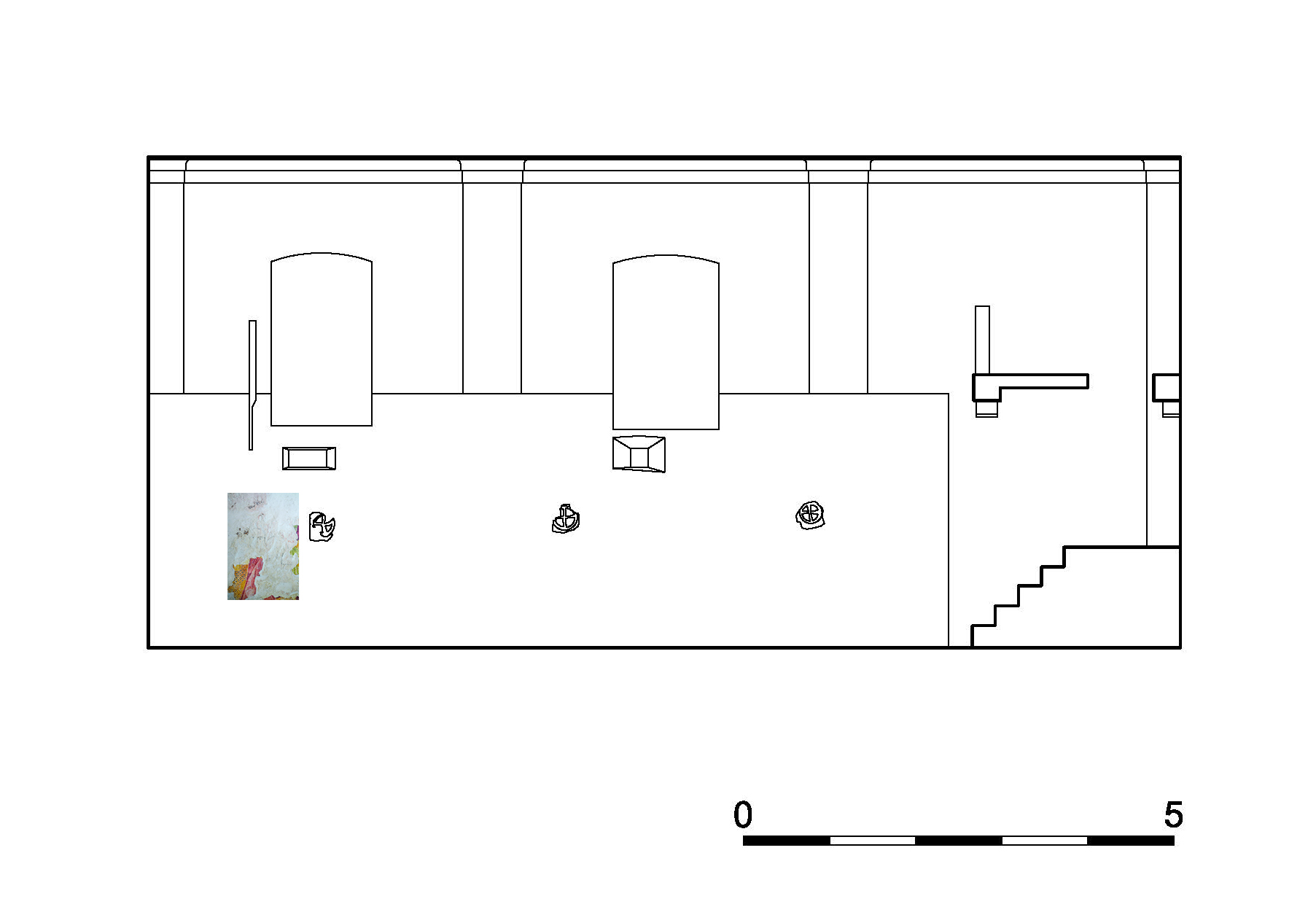

In 1997, during the restoration works on the southern wall of the nave, an older plaster was discovered under the preserved fragments of a 15th-century figure of a bishop in the lower part, where two faces were outlined in black and a consecrating cross was painted on the rough original plaster.[1]
________________________________________
[1] ČERV 1998, p. 143; KRIŽNAR 2006, p. 271.
Only a fragment of the mural has been preserved.
A part of a former Romanesque painting (?).
The 13th century (?).
Outlines of two faces.
The northern and southern wall
Pigments: white lime, carbon black
Analytical techniques: OM, Raman, XRD
During the collection of samples, the plaster felt soft but not brittle. To the eye and under the scalpel, it appeared bright and of good quality. The cross-sections of the two samples that were taken indicate different plasters. The one from the southern wall contains a lot of lime and very fine grains of sand (Fig. 1). It is also covered by a thin white layer of limewash, which is clearly visible under UV light (Fig. 2). The plaster from the northern wall contains larger sand grains, and there is no visible limewash (Fig. 2). The analyses with the XRD technique do not confirm any significant differences between the two: in both cases, they reveal a very similar plaster, composed of a high amount of binder (calcite) and not as much aggregate (dolomite, quartz). However, compared to the plaster from the southern wall, the one from the northern wall contains less dolomite and quartz, which could nevertheless indicate two separate paintings.
Both samples only feature a black colour layer. The granulation of the black pigment from the southern wall sample appears to be different compared to the sample from the northern wall: it is denser and more cohesive, while the black pigment on the northern wall consists of fine particles and is also mixed with white lime and a little bit of red earth (Figs 1, 3). However, in both cases, Raman analysis indicated carbon black. The primary binder is lime from the plaster, though the pigments may also have been impregnated with lime water or lime milk to increase their binding power.
It is clear that the lime technique was used on the southern wall, while the northern wall was painted al fresco.
On both the southern and northern walls, only the black underdrawings have been preserved. On the southern wall, the painter used a brush approximately one centimetre thick to outline the figures, of which only two heads remain visible. The faces are elongated and presented frontally, featuring long, almost horizontal eyebrows and slightly semicircular, large eyes with black irises. Long, straight noses protrude from both eyebrows, but none of them have been preserved in their entirety. The lips are outlined by two parallel lines, while a small beard is also defined with a short line. Many of the lines have been retouched. A black underdrawing was also used on the northern side: with quick strokes, equestrian figures of kings were drawn, and two of these still survive. We can make out swift, decisive strokes and a few corrections, for example on the belly of the first horse. The face has only been preserved in the case of the left figure: it is outlined very schematically, with a round head and merely implied eyes. The figures are slender and fashionably dressed. The two mural paintings are definitely separate: the one on the southern wall is older, while the one on the northern wall is more recent. This is also evidenced by the composition of the plaster and the black colour.
Volarje, Succursal church of St Brice, Stage 1 (Volarje), 2024 (last updated 29. 8. 2024). Corpus picturarum muralium medii aevi, https://corpuspicturarum.zrc-sazu.si/en/poslikava/phase-1-volarje/ (19. 9. 2026).
Legal Terms of Use
© 2026 ZRC SAZU UIFS, Corpus picturarum muralium medii aevi
ZRC SAZU
France Stele Institute of Art History
Novi trg 2
1000 Ljubljana


Spodaj seznam podrobno opisuje piškotke, ki se uporabljajo na našem spletnem mestu.
| Cookie | Type | Duration | Description |
|---|---|---|---|
| _ga | Non-Necessary | 2 years | This cookie is installed by Google Analytics. The cookie is used to calculate visitor, session, camapign data and keep track of site usage for the site's analytics report. The cookies store information anonymously and assigns a randoly generated number to identify unique visitors. |
| _gat | Non-Necessary | 1 minute | Google uses this cookie to distinguish users. |
| _gid | Non-Necessary | 1 day | This cookie is installed by Google Analytics. The cookie is used to store information of how visitors use a website and helps in creating an analytics report of how the wbsite is doing. The data collected including the number visitors, the source where they have come from, and the pages viisted in an anonymous form. |
| cookielawinfo-checkbox-necessary | Necessary | 1 year | This cookie is set by GDPR Cookie Consent plugin. The cookies is used to store the user consent for the cookies in the category "Necessary". |
| cookielawinfo-checkbox-non-necessary | Necessary | 1 year | This cookie is set by GDPR Cookie Consent plugin. The cookies is used to store the user consent for the cookies in the category "Non Necessary". |
| CookieLawInfoConsent | Necessary | 1 year | The cookie is used to store the summary of the consent given for cookie usage. It does not store any personal data. |
| PHPSESSID | session | Time of session | Cookie stores information about the user's session and allow users to keep their entries during the time of visiting the website. |
| pll_language | Necessary | 1 year | This cookie is used to remember any selection a user has made about language. |
| show_preloader_once | Necessary | Session | With this cookie we remember the user's first visit. |
| viewed_cookie_policy | Necessary | 1 year | The cookie is used to store whether or not you have consented to the use of cookies. It does not store any personal data. |
