
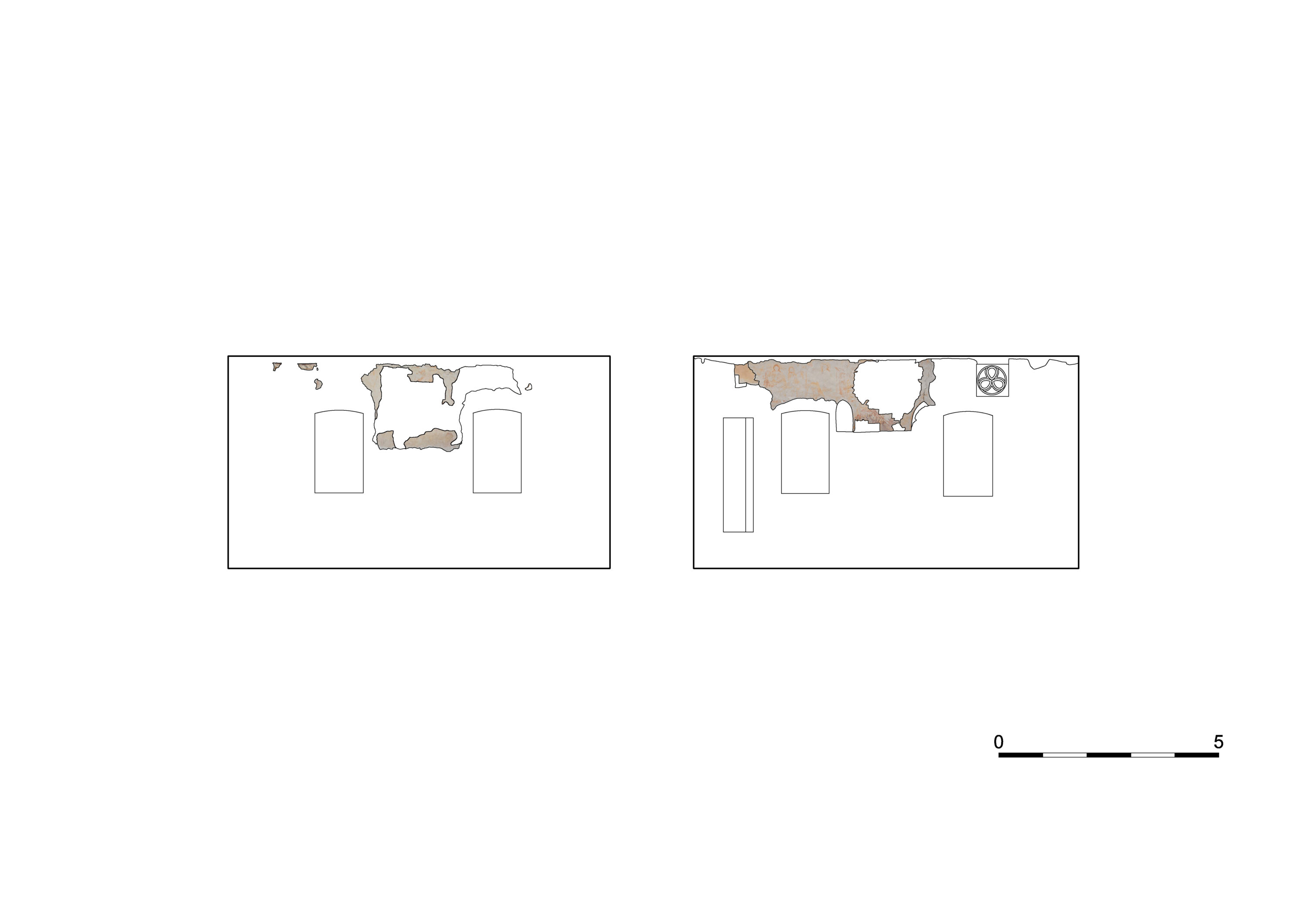

Fragments of murals have been preserved on the northern and southern walls of the nave. On the northern side, they are scattered along almost the entire length of the upper half of the wall. The fragment of the bordure on the western part of the northern wall just below the former flat wooden ceiling (the present one is set slightly higher) is best preserved. Below it, a now walled-up rectangular window was allegedly located,[1] outlined with a red line (at least on its right side). Originally, the bordure probably ran under the original flat ceiling throughout the church. However, its lower ochre-yellow band survives only above the parts of the preserved fragments on the eastern part of the northern wall. The simple bordure consists of a broad ochre-yellow stripe at the bottom, an equally wide reddish-brown stripe at the top, and a broader central band, which is white with alternating diagonal bands of grey, ochre, and red. Several fragments of older figural depictions are visible around the larger fragment of a 15th-century layer on the right half of the wall. A face at the left edge of the most recent layer depicting two soldiers is barely visible, while two crowned heads can be seen in the top centre: the king on the left does not have any facial hair, while the one on the right has a dark beard with a long curly moustache. Another barely distinguishable face is also visible at the right edge of the more recent layer, while two faces are also visible below. The right one, portrayed frontally and featuring long reddish curly hair, is better preserved. Fragments of both layers have also been preserved along the edge of the northern wall with the triumphal arch, but they are now obscured by the Baroque altar.
On the southern wall, the painter adapted his work to the architecture and placed the upper band of the painting between the flat wooden ceiling and the tops of the two pointed windows. This is indicated by the partially preserved bordure under the exposed scenes, running approximately at the highest point of the windows. The murals have been uncovered only above the eastern window (some remain under the whitewash, while the painting between the two walled-up Gothic windows is Baroque). The Last Supper scene with Christ in a strictly frontal posture in the centre, a row of five apostles on his left, and a more dynamic group on his right has been almost entirely preserved. Jesus is depicted strictly frontally, with curls of reddish hair falling on his shoulders. He has a short, combed beard painted with a few lines, almond-shaped eyes, and very broad cheekbones. The white patch on the left side of his chest probably represents the apostle John. Above him is St Peter with a bald spot on the crown of his head, while a dark-faced figure – Judas Iscariot – stands in front of the table below. Among the five apostles on Jesus’ left, the head of the apostle in the middle, differing from Jesus only in the differently shaped beard, is better preserved. The next scene, Jesus Prays on the Mount of Olives, shows a large figure of Jesus kneeling with his hands raised in prayer, facing the viewer’s left and a group of three sleeping apostles below him on the left. The next scene has not yet been fully uncovered. However, on the left edge, St Peter is nevertheless clearly identifiable as he uses his sword to cut off the ear of the high priest’s servant Malchus.
By the western window, on the upper left, a large part of a simple yellowish border is preserved, probably belonging to this phase. Except for a small fragment of plaster under the surviving bordure of the Last Supper scene, there is no specific evidence of any murals below the surviving upper band.
________________________________________
[1] SNOJ 2017, pp. 7–8, fig. 4.
Except a small piece of the bordure on the western part of the northern wall, the fragments are poorly preserved. Only the main lines and a few coloured surfaces are visible, while the modelling has almost completely disappeared.[1]
________________________________________
[1] The fragments may have been painted in the non-resistant tempera grassa technique, see SNOJ 2017, p. 3.
Despite the poor state of preservation, the individual parts are still sufficiently stylistically telling. The heads of the kings on the northern wall and especially the preserved scenes on the southern wall reveal a rather heterogeneous style. While parallels to the two kings could be found in the mural in the succursal church of St Cantianus in Vrzdenc – i.e. in the local tradition of the High Gothic linear style from the early 14th century – the faces of St Peter and Judas Iscariot in the Last Supper scene are still almost purely Romanesque. A significantly more advanced stylistic stage can be found in the figure of Jesus in the Last Supper scene. In the Slovenian territory, this scene can only be compared to that of St Christopher and another saint on the exterior of the succursal church of St John the Baptist in Zabočevo near Borovnica, dating to the middle of the 14th century. In addition to the distinctly curly hair and the facial type with almond-shaped eyes and a small mouth, the unknown saint in Zabočevo and the Leskovec Jesus, in particular, feature unusually broad cheekbones. Given the drastic difference in quality, we cannot speak of the possibility of the same artist. Instead, it seems that the Leskovec mural was painted by an artist trained in the conservative local tradition, who eclectically followed the newer trends.
Based on the parallels with the mural in the succursal church of St John the Baptist in Zabočevo near Borovnica, which was probably painted towards the middle of the 14th century, the murals in Leskovec probably originate from roughly the same time or at least from around the middle of the 14th century.
An unknown local painter.
Iconographically, only three scenes can be identified reliably and one conditionally. The two scenes on the northern wall – the Last Supper and Jesus Prays on the Mount of Olives – are the best preserved, while the third one, depicting Jesus’ arrest, survives only partially and can be identified by the preserved figure of St Peter cutting off the ear of the high priest’s servant Malchus with his sword. Based on the preserved fragment and its placement in the cycle, the scene before the Last Supper could be a depiction of Jesus’ solemn arrival in Jerusalem.
The two crowned figures on the northern wall likely belonged to the Adoration of the Magi – as the figures are portrayed very close together, it is less likely that this is the Procession scene.
The original painting probably represented an extensive Christological cycle. We can confidently assume that the entire upper part of the northern wall was painted in at least two bands. The murals on the southern wall must have been similar, though no horizontal caesuras (parts of the bordure, etc.) survive. The course and content of the cycle are not entirely clear from the preserved and currently uncovered scenes. It seems most likely that the cycle began on the northern wall with scenes from the life of Jesus up to the beginning of the Passion. The latter then started in the upper band on the left side of the southern wall. The three surviving scenes indicate that the cycle was not divided into fields of equal width (which is usual for the time of their creation). Thus, it is not entirely clear how many scenes preceded the Last Supper, but it was most probably one. According to the course of the salvation story, this could be Jesus’ triumphant arrival in Jerusalem. Currently, it is very difficult to assume how exactly the cycle continued on the southern wall, but the sequence of the three preserved scenes makes it very possible that the entire southern wall was adorned with a very detailed and extensive cycle.
The client was probably one of the Stična administrators who owned a court in Leskovec.
Pigments: white lime, orange earth (haematite-magnetite), red earth (haematite), organic black (unidentified)
Analytical techniques: OM, Raman
The plaster appears relatively bright, made of lime and an aggregate consisting of bright, angular sand grains, as indicated by the cross-sections (figs. 1–2). The chemical analyses using Raman spectroscopy identified calcite, dolomite, and quartz, while one of the samples may also contain alumosilicates, which would indicate the addition of sand or poorly washed aggregate. As only fragments of the mural have been preserved, we cannot speak of any giornate or pontate. The samples were taken by the restorer Saša Snoj during the restoration works in 2017, as due to its exceedingly high location, the mural is otherwise practically inaccessible.
The preserved colours and colour layers evident from the cross-sections suggest the use of earth pigments. This was also confirmed by the chemical analyses carried out at the Restoration Centre in Ljubljana, which identified white lime (calcite) and haematite-magnetite for the orange (fig. 1) and red colours. Some sort of black pigment, probably organic, was also used for the final contours or at least for the eyebrows. The primary binder is lime from the plaster and limewash, while an organic binder must have also been used for the final modelling and details. However, these have mostly fallen off already; unfortunately, we do not have any samples.
The mural was painted on a fresh support, directly on the plaster and/or on a layer of limewash. As a layer of thin limewash is clearly visible only on a single sample (fig. 2), we cannot be certain that it was used for the entire mural. Underneath the preserved figures, broad brushstrokes in various directions can be seen, definitely suggesting that the mural was probably painted in the lime technique. However, the colour layers do not seem to be peeling off the surface, which is very common for the lime technique. The final contours and modelling were most likely painted al secco, as they have mostly fallen off already.
The fragment of the bordure on the northern wall features thin incisions for horizontal, vertical, and diagonal lines. The underdrawing was made with a thin brush in red colour, as seen on the face of the king, visible from behind a more recent mural on the northern wall. We can clearly see how the painter drew the black contours of the eyebrows over the underdrawing (fig. 3). The figures of the Passion cycle on the southern nave wall are also outlined in red. The faces are shaped en face or in a three-quarter profile. The large eyes with a narrow outer corner stand out. On the southern wall, modelling with a broad light-red line has been preserved, overlapped with a darker brown line, while the final black contour, which is still visible on the northern wall, has fallen off (fig. 4). The eyes are completed with long, thin, and only slightly arched eyebrows. In all the frontal faces, the nose proceeds from both eyebrows, while in the case of three-quarter faces, it starts from the inner eyebrow. In some figures, it is slightly recessed at the root, while the nasal ridge runs straight towards the long, rounded tip. This is most clearly obvious in the dark red face in the first scene on the southern wall, which is unusual already due to its dark colour (fig. 4). None of the noses has been preserved in their entirety, so it is not possible to examine their entire shape. The beardless figures feature accentuated round chins, first outlined with a red underdrawing and accentuated with a black final contour. The hair and beards are outlined with parallel lines for the strands, while the colour modelling in light and dark ochre has been only partially preserved in the case of the royal figure on the northern wall (fig. 3). Hands only remain visible on the underdrawing. With broad palms and straight parallel fingers, they sometimes appear spatulate. The painter modelled the draperies in an interesting manner. He took the light tops of the creases into account already while applying the base colours and left them in the colour of the plaster/limewash (fig. 4). Probably, he subsequently emphasised them with highlights, which have fallen off. The same sort of modelling can be seen in both the northern and southern wall of the nave, and it is also recognisable in the hair design, which confirms that the murals were the work of the same painter or workshop.
Leskovec above Višnja Gora, Succursal church of St Oswald, Stage 1 (Leskovec above Višnja Gora), 2024 (last updated 29. 8. 2024). Corpus picturarum muralium medii aevi, https://corpuspicturarum.zrc-sazu.si/en/poslikava/phase-1-leskovec-nad-visnjo-goro/ (3. 12. 2025).
Legal Terms of Use
© 2025 ZRC SAZU UIFS, Corpus picturarum muralium medii aevi
ZRC SAZU
France Stele Institute of Art History
Novi trg 2
1000 Ljubljana


Spodaj seznam podrobno opisuje piškotke, ki se uporabljajo na našem spletnem mestu.
| Cookie | Type | Duration | Description |
|---|---|---|---|
| _ga | Non-Necessary | 2 years | This cookie is installed by Google Analytics. The cookie is used to calculate visitor, session, camapign data and keep track of site usage for the site's analytics report. The cookies store information anonymously and assigns a randoly generated number to identify unique visitors. |
| _gat | Non-Necessary | 1 minute | Google uses this cookie to distinguish users. |
| _gid | Non-Necessary | 1 day | This cookie is installed by Google Analytics. The cookie is used to store information of how visitors use a website and helps in creating an analytics report of how the wbsite is doing. The data collected including the number visitors, the source where they have come from, and the pages viisted in an anonymous form. |
| cookielawinfo-checkbox-necessary | Necessary | 1 year | This cookie is set by GDPR Cookie Consent plugin. The cookies is used to store the user consent for the cookies in the category "Necessary". |
| cookielawinfo-checkbox-non-necessary | Necessary | 1 year | This cookie is set by GDPR Cookie Consent plugin. The cookies is used to store the user consent for the cookies in the category "Non Necessary". |
| CookieLawInfoConsent | Necessary | 1 year | The cookie is used to store the summary of the consent given for cookie usage. It does not store any personal data. |
| PHPSESSID | session | Time of session | Cookie stores information about the user's session and allow users to keep their entries during the time of visiting the website. |
| pll_language | Necessary | 1 year | This cookie is used to remember any selection a user has made about language. |
| show_preloader_once | Necessary | Session | With this cookie we remember the user's first visit. |
| viewed_cookie_policy | Necessary | 1 year | The cookie is used to store whether or not you have consented to the use of cookies. It does not store any personal data. |
