

Pigments: presumably white lime, yellow ochre, red earth, green earth or malachite, azurite, lead pigments
Analytical techniques: /
Due to the mural’s inaccessibility, it has been impossible to take any samples for now, so the composition of the plaster has not been precisely determined. Visually, it is possible to assess that it is a classic plaster consisting of lime and sand.
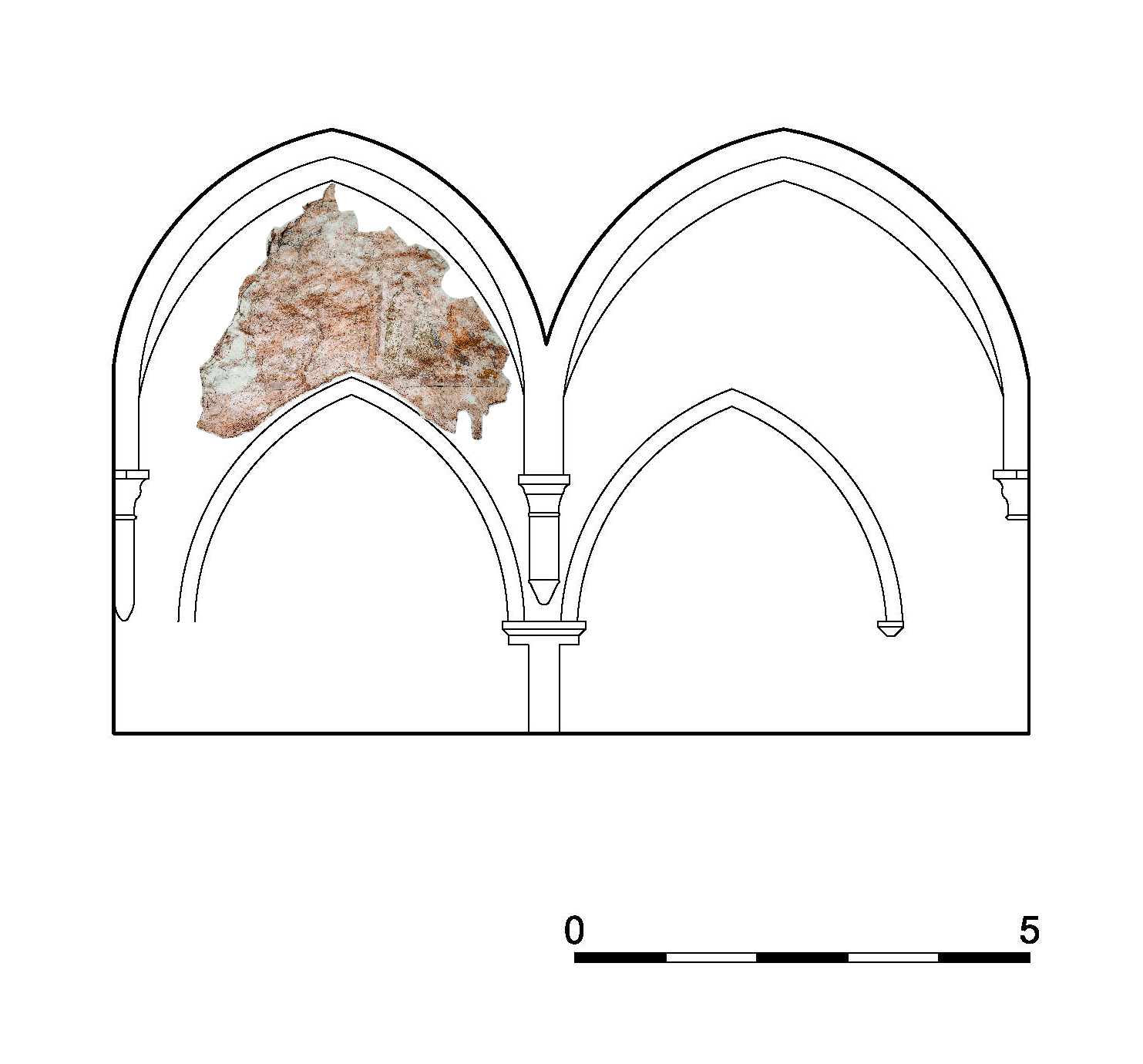
The pigments cannot be identified without a chemical analysis of the samples. Based on the preserved colours, it is possible to conclude that natural inorganic pigments suitable for painting on fresh plaster were mainly used: white lime, yellow ochre, red earth, green earth or malachite, and some organic black, perhaps lamp black or pit black. The background in the Death of Mary scene is partially blackened, while remains of black colour are also visible on some of the halos, possibly due to the degradation of azurite or some lead pigment (Fig. 1). At least in the case of the colour layers that are still partially preserved today, the binder must have certainly been lime from the plaster. However, given the poor state of preservation of the mural, where most of the colour layers have been lost, the top layers, which have fallen off by now, must have been completed with pigments impregnated with some organic binder such as animal glue, casein, or egg yolk.
Without samples, it is impossible to more precisely determine the painting technique. Given the state of the mural, we can assume that it was primarily painted on fresh plaster, but must have been finished al secco. The extent of the latter technique is impossible to determine. It is also impossible to discern whether the lime technique was also used.
Due to the poor condition of the mural, the painting process and modelling are difficult to discern. During the latest conservation works, test probing has revealed that the mural is, in fact, still partially covered with limewash and dirt accumulated over time and that some colours are still preserved underneath. A better evaluation will therefore need to wait until restoration works take place and the top layer is removed. It appears that the sleeve of the right hand of God the Father at the top of the scene (Fig. 1) was incised into the fresh plaster with thin incisions. The saints’ halos may have been incised just as thinly and almost imperceptibly, though the colour layers make it impossible to say for sure. The same is true of Mary’s bed, which may also have been incised. In the adjacent scene, which probably depicts the baptism of Christ, it is possible to make out a fragment of St John the Baptist’s halo with ray-shaped pouncings. The underdrawing was made with a red colour that can be detected in the upper part of the Death of Mary scene (Fig. 1; the red arrows). No faces have been preserved anywhere, though a hint of the round shape of the heads can still be discerned. The only preserved figure in the Baptism of Christ scene, probably Christ, has a stocky torso and legs that are too short. Behind it, a greenish colour surface (probably a river) with a dark band, which may also be blackened azurite or a lead pigment, has been preserved in the centre of the scene. At the lower right end, it seems that a part of St John the Baptist’s long fur cloak and the outline of his foot can still be seen. The preserved colour surfaces were applied using a thick brush, while no subsequent modelling is visible. The final contours were drawn with a strong, decisive black line, best preserved on the edges of the lower bordure.
Studenice, Parish church of the Three Kings, Stage 1 (Studenice), 2024 (last updated 12. 12. 2024). Corpus picturarum muralium medii aevi, https://corpuspicturarum.zrc-sazu.si/en/poslikava/phase-1-studenice/ (21. 9. 2026).
Legal Terms of Use
© 2026 ZRC SAZU UIFS, Corpus picturarum muralium medii aevi
ZRC SAZU
France Stele Institute of Art History
Novi trg 2
1000 Ljubljana


Spodaj seznam podrobno opisuje piškotke, ki se uporabljajo na našem spletnem mestu.
| Cookie | Type | Duration | Description |
|---|---|---|---|
| _ga | Non-Necessary | 2 years | This cookie is installed by Google Analytics. The cookie is used to calculate visitor, session, camapign data and keep track of site usage for the site's analytics report. The cookies store information anonymously and assigns a randoly generated number to identify unique visitors. |
| _gat | Non-Necessary | 1 minute | Google uses this cookie to distinguish users. |
| _gid | Non-Necessary | 1 day | This cookie is installed by Google Analytics. The cookie is used to store information of how visitors use a website and helps in creating an analytics report of how the wbsite is doing. The data collected including the number visitors, the source where they have come from, and the pages viisted in an anonymous form. |
| cookielawinfo-checkbox-necessary | Necessary | 1 year | This cookie is set by GDPR Cookie Consent plugin. The cookies is used to store the user consent for the cookies in the category "Necessary". |
| cookielawinfo-checkbox-non-necessary | Necessary | 1 year | This cookie is set by GDPR Cookie Consent plugin. The cookies is used to store the user consent for the cookies in the category "Non Necessary". |
| CookieLawInfoConsent | Necessary | 1 year | The cookie is used to store the summary of the consent given for cookie usage. It does not store any personal data. |
| PHPSESSID | session | Time of session | Cookie stores information about the user's session and allow users to keep their entries during the time of visiting the website. |
| pll_language | Necessary | 1 year | This cookie is used to remember any selection a user has made about language. |
| show_preloader_once | Necessary | Session | With this cookie we remember the user's first visit. |
| viewed_cookie_policy | Necessary | 1 year | The cookie is used to store whether or not you have consented to the use of cookies. It does not store any personal data. |
