
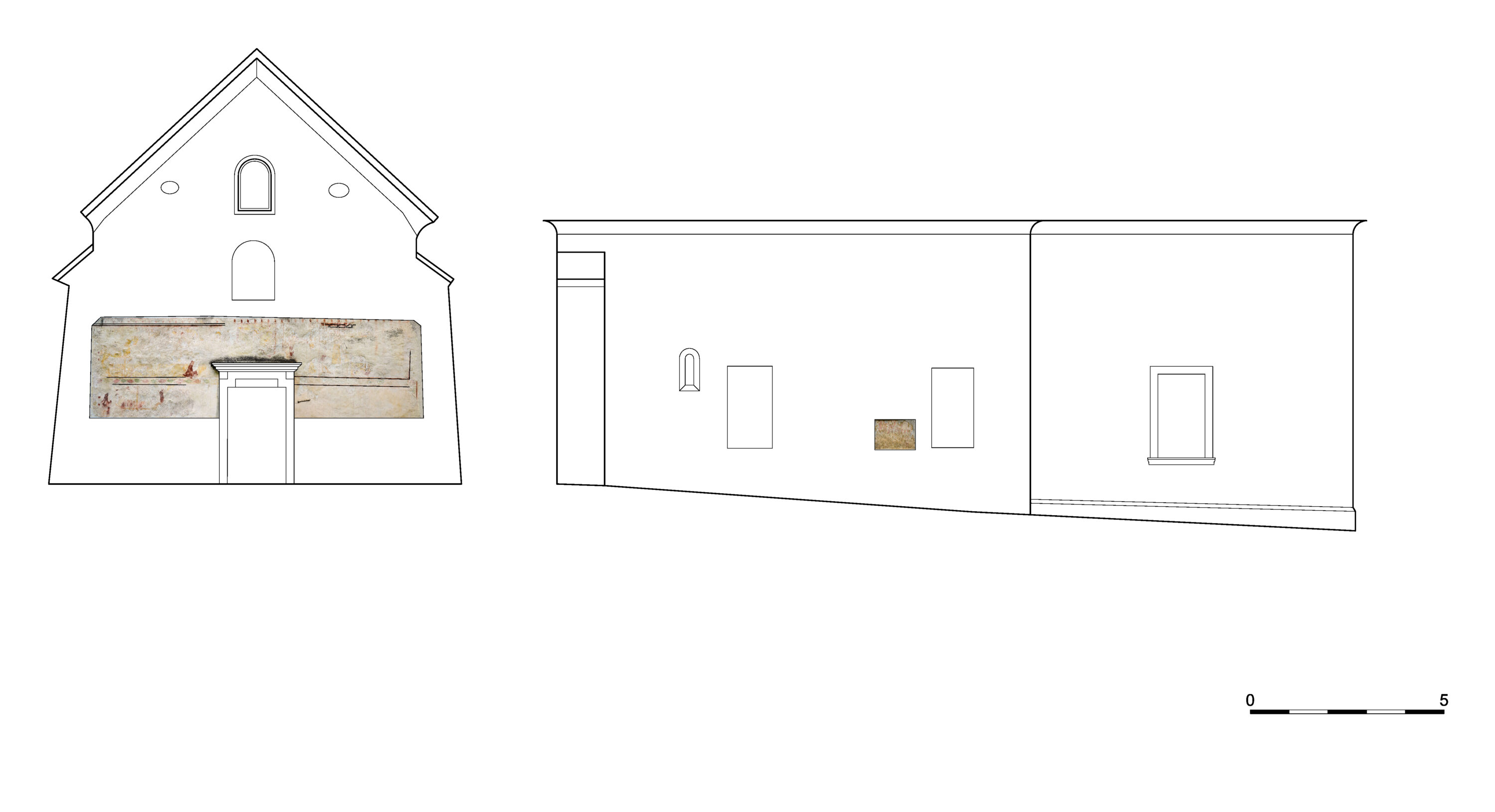

The mural is located on the exterior western wall of the nave. It is divided into two horizontal bands, with the lower one interrupted in the middle by the entrance portal opening.[1] From the viewer’s left to right, the upper band features the depictions of the Procession of the Magi, the Crucifixion, and three scenes from the legend of St Catherine.[2] In the lower band, the motif of St Nicholas calming the storm has been only partially preserved to the left of the portal, while the mural to the portal’s right has been destroyed.[3] At the same time as the main mural, a small fragment was also discovered on the southern exterior wall, but it is no longer discernible.[4]
In the upper band, the mural begins with the scene of the Procession of the Magi on the viewer’s left.[5] Only some partially preserved figures are visible, allowing for the identification of the motif. Various authors have identified images of horses, a camel, the figure of the eldest kneeling king, a dog showing its tongue, the heads of three servants, and the head of Mary. The descriptions of the scene in the relevant literature vary somewhat. For example, Ivan Stopar underlines that the scene contains a camel and that the king is holding a cup.[6] Tanja Zimmerman no longer mentions the image of the dog, which, however, is mentioned by Janez Höfler.[7] On the other hand, the latter also writes about the fragments of several horses but does not mention the images of the servants that Zimmermann highlights.[8] The camel does not reappear anywhere in the more recent descriptions. In the context of this scene, Janez Höfler mentions a bust of a female figure in the upper right corner above the left edge of the portal, which, in his opinion, is not a part of the Procession of the Magi.[9] Judging from the posture of her hands, he assumes that this is a remnant of the Virgin of Mercy with the mantle but excludes the possibility that this image could be part of the Virgin and Child from the scene of the Procession of the Magi, pointing out that the latter is no longer visible.[10]
The Crucifixion scene is depicted in the middle of the band, though only its upper part remains.[11] It shows a waist-up depiction of Christ on a branched cross (Astkreuz),[12] with Mary depicted on the viewer’s left with her head tilted back as she looks Christ in the eye.[13] Only the head with a drawing of the face and the halo have been preserved of her figure. A standing male figure – i.e. St John the Evangelist,[14] of whom only the hair is recognisable – is portrayed on the viewer’s right.
The scenes from the legend of St Catherine of Alexandria are painted to the right of the portal.[15] Three of them are still discernible: the Dispute with the Philosophers, Catherine’s Martyrdom on the Cross, and Catherine’s Martyrdom on the Breaking Wheel.[16] The first scene from the viewer’s left portrays a standing female figure, i.e. St Catherine. Facing left, she points to the book in front of her with her left hand.[17] A group of smaller human figures, who can be identified as the philosophers, is depicted on the left side.[18] In the next scene, St Catherine is hanging from a crossbar.[19] The two men representing executioners are depicted lashing the saintess.[20] The only identifiable features of the final scene include the smashed breaking wheel and the three figures lying on the ground because they have been injured by splinters.[21]
The lower band of the mural is preserved only on the left side, where the motif of St Nicholas calming the storm was depicted.[22] In the older reproductions, the ship with the mast, climbed by one of the sailors, is still clearly recognisable.[23] Five figures are placed on the left side of the mast from the viewer’s perspective, while two are visible on the right. With their hands folded in prayer, they face St Nicholas at the far right end of the ship.[24] The saint is depicted wearing a bishop’s vestment with a mitre, his right hand partially raised in blessing.[25] On the viewer’s left is a partially preserved image of the devil with a staff, symbolising the storm, while below him is a black dog with an open snout.[26]
The scenes in the upper band are framed by a folded ribbon, while the bordure separating the two bands of the mural consists of alternating green and red diamonds.[27] On the left side of the portal, these are interpreted as images of fish, while on the right side of the portal, Tanja Zimmermann identified them as lizards[28] and Janez Höfler recognised a badger.[29]
We should also underline the fragment of the mural painted in the same style, uncovered on the southern exterior wall of the nave.[30] It was only detailed by Ivan Stopar in his conservation report,[31] but nowadays, the scene is no longer recognisable.[32] Only the lower part of a group of figures was once preserved here, and Christ was supposedly depicted among them. However, it was no longer possible to identify the scene depicted in this spot.[33]
________________________________________
[1] STOPAR 1979, p. 362; ZIMMERMANN 1996, pp. 84–85; HÖFLER 2004, p. 150.
[2] Ivan Stopar did not yet identify the scenes from Catherine’s legend; see STOPAR 1979, p. 362; ZIMMERMANN 1996, pp. 84–85; HÖFLER 2004, p. 150.
[3] STOPAR 1979, p. 362; ZIMMERMANN 1996, p. 85; HÖFLER 2004, p. 151.
[4] STOPAR 1979, p. 362; HÖFLER 2004, p. 151.
[5] STOPAR 1979, p. 362; HÖFLER 2004, p. 151.
[6] STOPAR 1979, p. 362.
[7] ZIMMERMANN 1996, p. 85; HÖFLER 2004, p. 150.
[8] ZIMMERMANN 1996, p. 85; HÖFLER 2004, p. 150.
[9] HÖFLER 2004, p. 150.
[10] HÖFLER 2004, p. 150.
[11] STOPAR 1979, p. 362; ZIMMERMANN 1996, p. 85; HÖFLER 2004, p. 150.
[12] ZIMMERMANN 1996, p. 85.
[13] HÖFLER 2004, p. 150.
[14] Regarding the image of St John the Evangelist, HÖFLER 2004, p. 150, stated that it was not visible and that there was supposedly not enough space for it on the right side.
[15] ZIMMERMANN 1996, pp. 84–85; HÖFLER 2004, p. 150.
[16] ZIMMERMANN 1996, pp. 84–85, named the Dispute with the Philosophers scene as Catherine Teaches the Philosophers; cf. HÖFLER 2004, p. 150.
[17] ZIMMERMANN 1996, p. 85; HÖFLER 2004, p. 150.
[18] HÖFLER 2004, p. 150.
[19] ZIMMERMANN 1996, p. 85.
[20] ZIMMERMANN 1996, p. 85.
[21] ZIMMERMANN 1996, p. 85.
[22] STOPAR 1979, p. 362; ZIMMERMANN 1996, p. 85; HÖFLER 2004, p. 151.
[23] HÖFLER 2004, p. 151.
[24] STOPAR 1979, p. 362.
[25] STOPAR 1979, p. 362; ZIMMERMANN 1996, p. 85; HÖFLER 2004, p. 151.
[26] ZIMMERMANN 1996, p. 85; HÖFLER 2004, p. 151.
[27] STOPAR 1979, p. 362; HÖFLER 2004, p. 150.
[28] ZIMMERMANN 1996, p. 85.
[29] HÖFLER 2004, p. 150.
[30] STOPAR 1979, p. 362.
[31] STOPAR 1979, p. 362.
[32] HÖFLER 2004, p. 151.
[33] STOPAR 1979, p. 362.
The mural is extremely poorly preserved, mainly due to its exposure to the elements, as it is located on the western façade of the church. Because of the faded colour layers, it is very difficult to discern in situ.[1] Already during its uncovering in 1977, it was only fragmentarily preserved, as none of the scenes were visible in their entirety any longer.[2] Still, faint traces of painting and drawing can still be detected where darker colours were used.
________________________________________
According to the time of its creation, the Podčetrtek mural should be classified as the so-called hybrid, transitional, or mixed style, typical of murals in the territory of today’s northern Slovenia in the second half or the last third of the 14th century.[1] However, due to its stylistic characteristics, it belongs to the older, so-called High-Gothic linear style.[2] These characteristics include strong drawings, uniform colour surfaces without any shading, and elongated figures. Due to its poor preservation, it was assumed that the mural was painted on dry plaster.[3] However, technical analyses have revealed it was made using the al fresco technique.[4]
In terms of its composition, the mural still follows the basics of the drawing style that does not yet use perspective in spatial design. Thus, the space in the Procession of the Magi and Catherine’s Martyrdom on the Breaking Wheel scenes is still depicted flatly: the figures are arranged in the foreground against a monochrome background and painted in a manner typical of the 14th century. Tanja Zimmermann associates them with the Czech artistic influences.[5] In the facial type of the Apocalyptic Woman, painted in St Mary’s Church at the Karlstejn Castle in Czechia (c. 1360–1362), she discovered stylistic similarities with the design of the faces of the servant of the oldest king, Mary, and St Catherine in Podčetrtek.[6] To this, Janez Höfler also added the silhouette of the old king of Podčetrtek, which could also have been created under the influence of the images from Karlstejn Castle.[7] The female figures characteristically feature oval faces with hair combed back,[8] while high foreheads are a prominent feature of the male figures.[9] Based on this comparison, Janez Höfler attributed the influences to the earlier Czech style from shortly after the middle of the 14th century.[10]
________________________________________
[1] KRIŽNAR 2006, p. 64.
[2] HÖFLER 2004, p. 151; KRIŽNAR 2006, pp. 64, 214.
[3] HÖFLER 2004, p. 151.
[4] KRIŽNAR 2006, p. 215.
[5] HÖFLER 2004, p. 151.
[6] ZIMMERMANN 1996, p. 85.
[7] HÖFLER 2004, p. 151.
[8] ZIMMERMANN 1996, p. 85.
[9] HÖFLER 2004, p. 151.
[10] HÖFLER 2004, p. 151. ZIMMERMANN 1996, p. 85, also looked for comparisons in the works of Johannes Aquila’s painting workshop from the 1370s and 1380s. Cf. HÖFLER 2004, p. 151, who rejected such a stylistic connection and pointed out that it had not yet been researched how the influences of the earlier Czech style had reached Styria at that time.
The creation of the mural under consideration is dated to around 1360 or the third quarter of the 14th century.[1]
________________________________________
[1] Tanja Zimmermann dated the murals’ creation to the third quarter of the century, while Janez Höfler limited the time to around 1360, see ZIMMERMANN 1996, pp. 86, 209; HÖFLER 2004, p. 151; cf. KRIŽNAR 2006, p. 214.
Unknown.
The inclusion of more people in the scenes than just the protagonists and a greater emphasis on narrative are characteristic of the period in which the Podčetrtek murals were painted.[1] The Procession of the Magi scene follows the tradition of depiction that became established in the Eastern Alpine area in the second quarter of the 14th century and already included genre motifs and extended entourages.[2] In the middle of the 14th century, depictions of St Catherine of Alexandria’s legend were increasingly often included in mural paintings.[3] The scheme used by the artist in the Podčetrtek church does not distinguish itself from other contemporary examples.[4] The scene from the legend of St Nicholas also became a more frequent mural painting motif in the middle of the 14th century or in its second half.[5] Tanja Zimmermann attributed the depiction of the St Nicholas’ legend to the influence of Italian art, as the cult of this saint had spread from Italy.[6] However, the Crucifixion is the central motif of the mural on the western façade of the church in Podčetrtek.
________________________________________
[1] ZIMMERMANN 1996, p. 164.
[2] ZIMMERMANN 1996, p. 86.
[3] ZIMMERMANN 1996, p. 86.
[4] ZIMMERMANN 1996, p. 86. In this regard, the author pointed out that a similar iconographic scheme was also painted in two other cases in Austrian Carinthia, namely in the branch church in Remschnigg and the ossuary in Feistritz bei Grades.
[5] ZIMMERMANN 1996, p. 86.
[6] ZIMMERMANN 1996, p. 163.
Pigments: white lime, yellow and red earth, green earth
Analytical techniques: OM, FTIR
The plaster is rather coarse, containing large grains of varicoloured sand, which are clearly visible in the cross-sections of the samples (fig. 1). It is quite hard, which suggests that it is rich in lime. Laboratory analyses by X-ray diffraction could not be performed because the quantity of the samples taken was insufficient. IR spectroscopy confirmed a high calcium carbonate (lime) content compared to silicates (sand). The surface of the wall is fairly ondulate and the boundaries between giornate are not detectable, at least not in the lower area. It is not possible to determine how many layers of plaster the artist used to paint on. Given the early date of the painting and especially the coarse composition of the plaster, we can assume that he only applied a single yet slightly thicker layer.
Few colours have been preserved, but already their hue suggests an earth origin: yellow and red earth and green earth, i.e. alumosilicates and iron oxides. The yellow and the red colours are the most enduring. The FTIR analysis of the samples did not reveal the presence of any organic materials (binders) but confirmed the presence of carbonates, especially calcium carbonate, which therefore functioned as the primary binder.
Despite the poor preservation and the blurred colours, the technique used was painting on fresh plaster. The preserved colour layers stick firmly to the base and do not peel off. The plaster had to be applied on larger surfaces and painted quickly. As it was drying, the final paint layers no longer bonded well, so by now, parts of the majority of colours have fallen off. In some places, the painter refreshened the survace by applying a layer of lime whitewash, which also served as a kind of underpainting for further modelling. On the faces and hands, the thin limewash layer makes the colours appear as if applied in relief, while a thin layer of limewash between the plaster and the paint layer is also revealed by the cross-sections (fig. 2). The artist therefore painted both the underdrawing and the local tones mostly on fresh plaster. However, in some cases, he also modelled on fresh plaster, as seen in the design of the draperies. The cross-sections indicate that the preserved paint layers are mostly very thin. The final additions and modelling were probably painted dry, but they no longer exist today. The poor state of preservation is mainly attributable to the exterior location of the mural and numerous detrimental atmospheric factors (changes in temperature and humidity due to the weather, air pollution, etc.).
The mural in question does not feature any sinopia, incisions, or pouncing. The underdrawing is clearly visible as much of the paint layers have fallen off. The painter used red colour to outline the edges of the bordures, the diamond ornaments, the borders and the red dots between the scenes, and the individual figures. The drawing is quite precise and served the painter as a guide when completing the final contours. The latter follow the lines of the underdrawing but made in a darker red, almost brown colour. There was probably no underpainting, but we can discuss the local tones, which the painter used to fill larger areas such as draperies and backgrounds. The red and yellow bases on which the painter subsequently modelled have survived. As the mural is very poorly preserved, it is difficult to discern the colour modelling. It is obvious that in several places, the painter used the whiteness of the plaster as a base on which to model both the clothes and the faces. The latter are round, softly shaped, and modelled in pink colour on a white base (whitewash) (fig. 2). The eyebrows are long and slightly arched. The upper edge of the eyes is also rounded, while the lower line is straight, giving the eyes a slightly almond-like, elongated shape. The upper eyelid is also emphasised with a line. The nose is beautifully shaped in some places, while in others, it appears thick and flattened. The tip of the nose and both nostrils are emphasised as well. The mouth is exquisitely outlined with a thicker line that separates the two lips while simultaneously filling the heart-shaped upper lip. Meanwhile, the lower lip is outlined with a semicircular line, conveying the impression of fullness. The shaded corners are reminiscent of the Czech manner of modelling. The hands are narrow and beautifully shaped in some places but more stocky and schematic in others. The latter are probably the work of an assistant.
The hair is mainly designed on an ochre-yellow colour base, using sinuous darker lines to create curls. The highlighted areas (the tops of the curls) were painted with a lighter, more diluted paint than the other areas, creating a play of light and shadow. The best way to assess the painter’s use of the plaster’s whiteness is to look at how the drapery was designed. In the case of darker cloaks, we can see how he left the parts that represent the highlights uncoloured (especially the tops of the folds). For the light draperies, he simply outlined the wrinkles on the plaster with yellow or red, in the chosen colour, and added depth shadows, thus already creating light-dark effects. Finally, he concluded the work with a dark red contour. There are no motifs that called for the use of stencils.
Podčetrtek, Parish church of St Lawrence, Stage 1 (Podčetrtek), 2024 (last updated 30. 8. 2024). Corpus picturarum muralium medii aevi, https://corpuspicturarum.zrc-sazu.si/en/poslikava/phase-1-church-of-st-lawrence-podcetrtek/ (21. 9. 2026).
Legal Terms of Use
© 2026 ZRC SAZU UIFS, Corpus picturarum muralium medii aevi
ZRC SAZU
France Stele Institute of Art History
Novi trg 2
1000 Ljubljana


Spodaj seznam podrobno opisuje piškotke, ki se uporabljajo na našem spletnem mestu.
| Cookie | Type | Duration | Description |
|---|---|---|---|
| _ga | Non-Necessary | 2 years | This cookie is installed by Google Analytics. The cookie is used to calculate visitor, session, camapign data and keep track of site usage for the site's analytics report. The cookies store information anonymously and assigns a randoly generated number to identify unique visitors. |
| _gat | Non-Necessary | 1 minute | Google uses this cookie to distinguish users. |
| _gid | Non-Necessary | 1 day | This cookie is installed by Google Analytics. The cookie is used to store information of how visitors use a website and helps in creating an analytics report of how the wbsite is doing. The data collected including the number visitors, the source where they have come from, and the pages viisted in an anonymous form. |
| cookielawinfo-checkbox-necessary | Necessary | 1 year | This cookie is set by GDPR Cookie Consent plugin. The cookies is used to store the user consent for the cookies in the category "Necessary". |
| cookielawinfo-checkbox-non-necessary | Necessary | 1 year | This cookie is set by GDPR Cookie Consent plugin. The cookies is used to store the user consent for the cookies in the category "Non Necessary". |
| CookieLawInfoConsent | Necessary | 1 year | The cookie is used to store the summary of the consent given for cookie usage. It does not store any personal data. |
| PHPSESSID | session | Time of session | Cookie stores information about the user's session and allow users to keep their entries during the time of visiting the website. |
| pll_language | Necessary | 1 year | This cookie is used to remember any selection a user has made about language. |
| show_preloader_once | Necessary | Session | With this cookie we remember the user's first visit. |
| viewed_cookie_policy | Necessary | 1 year | The cookie is used to store whether or not you have consented to the use of cookies. It does not store any personal data. |
