
List of paintings
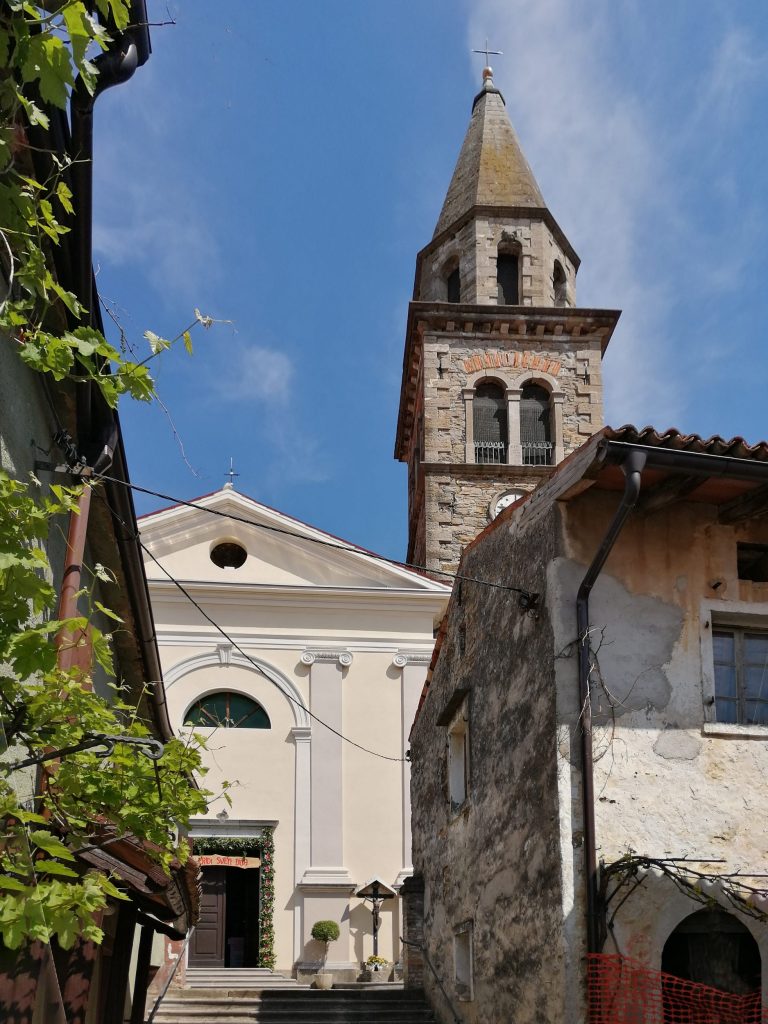
The information in the preserved written sources indicates that the original church in Biljana could have existed as early as the 11th century, when around the year 1090, Patriarch Ulrich I of Eppenstein or his brother Henry granted the ancient parish of Bračan with all its succursal churches, probably including the one in Biljana, to the newly reformed Benedictine monastery of St Peter in Rožac.[1] In the sources, the church was first referred to in 1233[2] – though indirectly, by mentioning the parish. However, in 1405 and 1445, we can also note the reference to its dedication to St Michael.[3] Until the end of the 15th century, the parish was under the full rights of the Benedictine monastery in Rožac, which also exercised its authority as the archdeaconate. Afterwards, it was under the patronage of the Emperor or the Provincial Prince.[4]
________________________________________
[1] Cf. HÖFLER 2016, p. 158; HÖFLER 2022, pp. 9, 84–85.
[2] In 1233, Patriarch Berthold settled the dispute between Conrad, the Archdeacon of the Church of Aquileia, and the Abbot of Rožac concerning the jurisdiction over the churches of de Albana, Bricana et Villana in favour of the Abbot of Rožac; cf. SWIDA 1888, pp. 408–410, n. 7; KOS, KOS 1928, p. 290; HÖFLER 2022, p. 85. For example, in the list of papal duties for the Aquileian patriarchate from 1296, the church in the Goriška Brda hills is listed among the vicariates of Rožac (vicarius de Beliano); cf. SELLA, VALLE 1941, pp. 18–19; quoted after QUINZI 1999, p. 5, n. 3; cf. HÖFLER 2022, p. 85.
[3] HÖFLER 2022, p. 85. The first reference to the church’s dedication in 1405 is related to the Orzon family, which later established itself as an important church donor. Among the last wishes of Jakob from Dobrova, the son of the man named Yonamo de Orzono habitatore in Dobraw, the testament also mentions the burial in apud ecclesiam sti Michaelis de Bigliana, parochialem ecclesiam in Belyano; cf. KOS 1902, p. 107, n. 53; QUINZI 1999, p. 5.
[4] HÖFLER 2016, p. 160; HÖFLER 2022, p. 85. For more information about the parish of Biljana after its transition to the Habsburg rule, see STRES 2015, pp. 28–39.
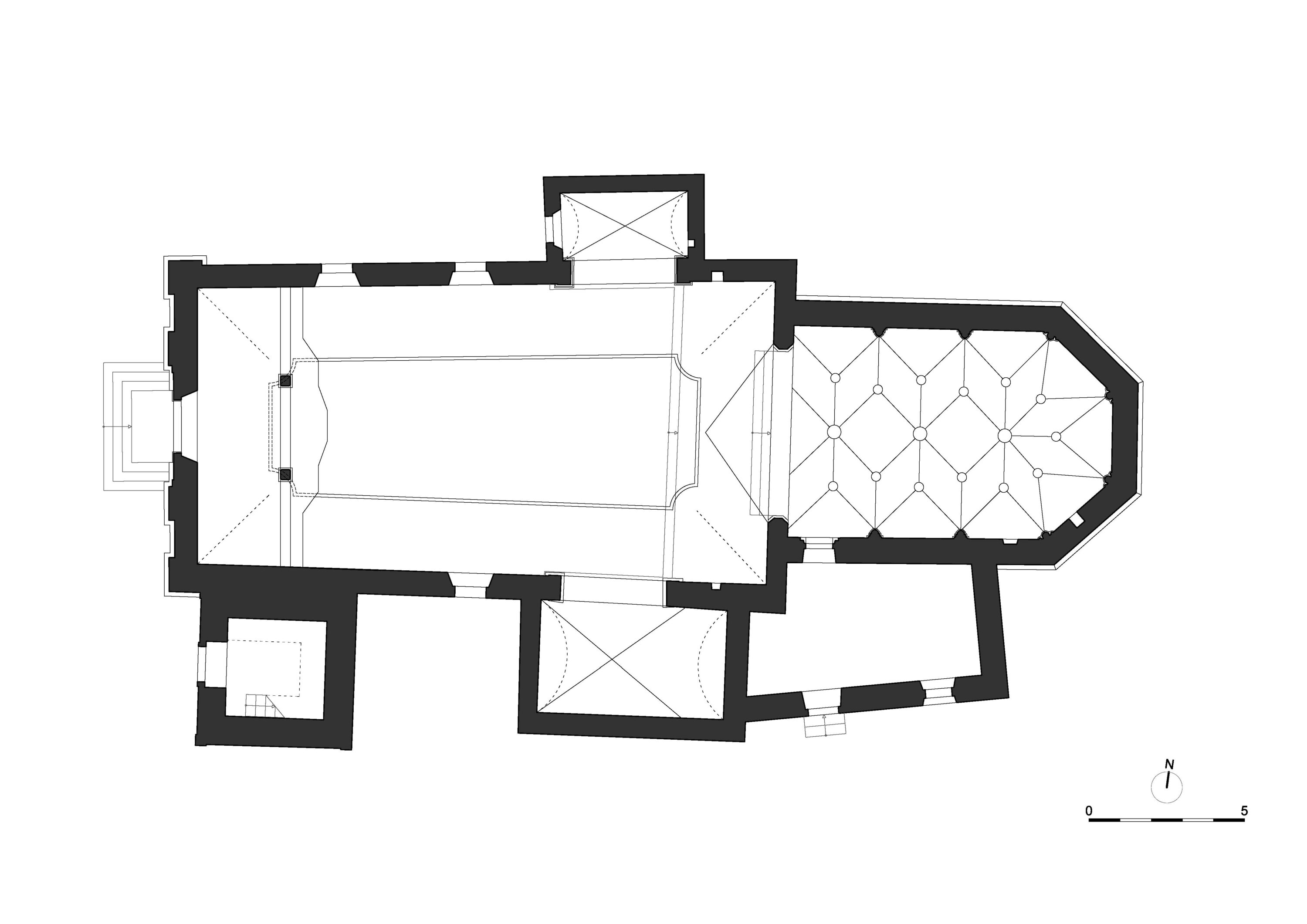
The medieval church nave, preserved to this day, dates back to at least the beginning of the 14th century. A monumental Gothic chancel was added to it in 1534.[1] During the Baroque period, the interior of the church underwent quite a few changes. At that time, both side chapels were probably added,[2] and it also received new stone altar furnishings.[3] At the end of the 19th century and the beginning of the 20th century, the nave was raised and extended by the width of the choir loft, while the church received a new façade and a new belfry.[4] In 1903, the roof of the chancel was renewed. In the same year, Clemente Del Neri painted the chancel ceiling, while in 1910, he also painted the nave.[5]
________________________________________
[1] For more information about the choir, see “The state of research” section.
[2] The left side chapel contains a stone Baroque column altar of St Blaise with the altarpiece Sv. Blaž med sv. Janezom Nepomukom in sv. Frančiškom Ksaverijem, which QUINZI 1999, p. 5, n. 44, attributed to the painter Johann Michael Lichtenreiter from Gorizia. In the right side chapel stands the altar of Madonna of the Rosary from before the middle of the 18th century with an altarpiece from the same period, in which QUINZI 1999, pp. 16–17, identified the image of the patron, Peter Adam Zupančič (Suppanzig) (1679–1780), a native who had served as the parish priest in his hometown between 1735 and the middle of the 18th century. In the background, the author also recognised the medieval Biljana church nave. For more information about Peter Adam Zupančič, see MORELLI DE SCHÖNFELD 1855, pp. 353–354.
[3] The altar of St John the Baptist, attributed to the Pacassi workshop from Gorizia, is located by the triumphal arch on the right side; cf. VRIŠER 1983; STRES 2015, p. 23. The inscription on the marble altarpiece pedestal states that the altar was commissioned and paid for in 1695 by Janez Dominik Collussi, the third chaplain of the church. Above the altarpiece of Christ’s baptism in the Jordan, a coat of arms is located on the arch’s apex. The coat of arms of the Orzon family, which had a benefice at the altar, is carved into the left half of the cartouche. Meanwhile, Alessandro Quinzi assumes that the coat of arms carved into the right half of the cartouche may belong to Baron Bernard Zaletel (Saleteu), whom the sources mention, in 1750, as the founder of the benefice at the altar of St John the Baptist; cf. ATTEMS 1994, pp. 75–77; QUINZI 1999, pp. 8, 13–14. For more information about the altar and the altarpiece, see QUINZI 1999, pp. 8, 16, n. 47. Along the right triumphal arch is the Baroque altar of St Catherine, while the high altar was commissioned in 1774 by Canon Andrej Friderik Zupančič (And[reas] Frid[ericus] Suppanzigh) from Zali Breg, as attested to by the inscription plaque on the back of the altar; see PREMRL 2011, p. 38. About the discovery of the Baroque mural on the wall behind the high altar in the chancel, see JAZBEC, BENSA 2010, p. 24.
[4] This information can be inferred from the inscription above the triumphal arch in the chancel: NAVIS / ECCLESIAE / PROLONGATA, EXALTATA / ATQUE PRESBYTERIO / NOVUM TECTUM IMPOSITUM / FUIT ANNO D[OMI]NI 1903 / PRESBYTERIUM VERO FUIT / PINCTUM ANNO D[OMI]NI 1905 / PAROCHO / LUDOVICO KUMAR. The transcription quoted after PREMRL 2011, p. 37. For more information about the construction of the belfry after 1891, see especially STRES 2015, pp. 52–54. It is not entirely clear where the old church belfry stood, as no known source mentions it. Its location is not even visible on the floor plan of the Biljana Church from the Franciscan cadastre (Archivio di Stato di Gorizia, Franciscejski kataster, Bilgliana 305). Based on the depiction of the Biljana Church on the altarpiece of the mid-18th century altar of Madonna of the Rosary in the southern side chapel of the Parish Church in Biljana, it appears that the belfry stands on the site of (or next to) the northern Baroque side chapel.
[5] The painter signed his name at the beginning of the vault in the middle section of the angel’s inscription band: Pinxit Cl[emente] Del Neri a[nno] 1905 in NAVIS ECCLESIAE PINCTA a[nno] d[omini] 1910 C[LEMENTE] DELNERI p[inxit]. The transcription quoted after PREMRL 2011, p. 38.
Most of the research related to the church of St Michael has focused on the architecture of its late Gothic choir, dated 1534 on the keystone. Judging from one of the preserved mason’s marks, Ivan Komelj attributed the choir to a master who had signed his name as Magister de Crainburg in 1526 in the parish church in the village of Oprtalj.[1] The chancel architecture was studied more meticulously by Robert Peskar, who was particularly interested in the extent of Master of Kranj’s personal involvement as the master builder of the church in Biljana.[2] Based on the newly discovered mason’s mark of the builder Štefan on the choir vault in the Church of St Luke in Spodnje Prapreče, which is identical to the mark of the Master of Kranj, Samo Štefanac proved that this was in fact the same master who had worked in Prapreče as well as in Biljana, Oprtalj, and Buzet.[3]
Interestingly, the professional scientific publication Varstvo spomenikov has not published any reports on the restoration interventions carried out during the 1990s and at the beginning of 2000. After the fresco on the southern wall had been uncovered, Alessandro Quinzi devoted a lengthy article to the church, focusing on its medieval history and on the stylistic analysis of the fresco, which he placed in the circle of Vitale da Bologna’s collaborators and dated it to the 1350s. He also touched upon the building’s Baroque renovation and the Orzon family as the church’s donors between the 15th century and the Baroque period.[4] After him, Božidar Premrl included an extensive chapter on the Church of St Michael in his overview of sacral architecture in the Goriška Brda hills in his work titled Briški teri,[5] while Peter Stres dedicated several chapters to the Biljana church and its history in his book focusing on the history of the parish and municipality of Biljana.[6] The literature also mentions a wooden Gothic statue of Christ from the beginning of the 16th century, which originally stood on the former Gothic high altar,[7] and five wooden sculptures preserved on the corbels under the Gothic baldachins in the chancel.[8]
ATTEMS 1994
Karel Mihael ATTEMS, Atti delle visite pastorali negli arcidiaconati di Gorizia, Tolmino e Duino dell’arcidiocesi di Gorizia/Vizitacijski zapisniki goriškega, tolminskega in devinskega arhidiakonata goriške nadškofije/Die Berichte der Pastoralvisitationen in den Archidiakonaten Görz, Tolmin und Duino der Erzdiözese Görz 1750–1759 (edd. Franc Kralj, Luigi Tavano), Gorizia 1994.
CEVC 1967
Emilijan CEVC, Gotsko kiparstvo, Ljubljana 1967.
CEVC 1970
Emilijan CEVC, Poznogotska plastika na Slovenskem, Ljubljana 1970.
CEVC 1973
Emilijan CEVC, Gotska plastika na Slovenskem, Ljubljana 1973.
CEVC 1981
Emilijan CEVC, Kiparstvo na Slovenskem med gotiko in barokom, Ljubljana 1981.
HÖFLER 2016
Janez HÖFLER, O prvih cerkvah in župnijah na Slovenskem. K razvoju cerkvene teritorialne organizacije slovenskih dežel v srednjem veku, Ljubljana 20162.
HÖFLER 2022
Janez HÖFLER, Historična topografija predjožefinskih župnij na Slovenskem. Primorska (Oglejski patriarhat, Tržaška škofija), Ljubljana 20223.
JAZBEC, BENSA 2010
Andrej JAZBEC, Marta BENSA, Biljana, Varstvo spomenikov. Poročila, 46, 2010, p. 24.
KOMELJ 1973
Ivan KOMELJ, Gotska arhitektura na Slovenskem. Razvoj stavbnih členov in cerkvenega prostora, Ljubljana 1973.
KOS 1902
Franc KOS, Iz arhiva sig. Attemsa v Podgori, Izvestja muzejskega društva za Kranjsko, 12/5, 1902, pp. 57–84, 97–131, 137–176.
KOS, KOS 1928
Franc KOS, Milko KOS, Gradivo za zgodovino Slovencev v srednjem veku. 5: 1201–1246, Ljubljana 1928.
MORELLI DE SCHÖNFELD 1855
Carlo MORELLI DE SCHÖNFELD, Istoria della Contea di Gorizia, Gorizia 1855.
PAVLINEC 1972
Ivan PAVLINEC, Iz prakse restavriranja lesene plastike, Varstvo spomenikov, 16, 1972, pp. 103–108.
PESKAR 1995
Robert PESKAR, Biljana, Gotika v Sloveniji (ed. Janez Höfler), Narodna galerija, Ljubljana 1995, pp. 101–102.
PESKAR 2011
Robert PESKAR, Gotska arhitektura na Goriškem. Stavbarske delavnice 1460–1530, Nova Gorica 1999.
PREMRL 2011
Božidar PREMRL, Briški teri. Zgodbe cerkva in zvonikov v Brdih, Sežana 2011.
QUINZI 1999
Alessandro QUINZI, »Et capella tota sanctorum figuris depicta est«. K srednjeveški podobi cerkve svetega Mihaela v Biljani, Acta historiae artis Slovenica, 4, 1999, pp. 5–19.
SELLA, VALLE 1941
Pietro SELLA, Giuseppe VALLE, Venetiae, Histria, Dalmatia. Rationes decimarum Italiae nei secoli XIII e XIV, Città del Vaticano 1941 (Studi e testi, 96).
STRES 2015
Peter STRES, Biljana. Oris preteklosti župnije in občine Biljana ter naselij Biljana in Zali Breg od prve omembe vasi Biljana leta 1205 do priključitve k Jugoslaviji septembra 1947, Gorica 2015.
SWIDA 1888
Francesco SWIDA, Documenti friulani e goriziani dal 1126 al 1300, Archeografo Triestino, n. s. 2, 14, 1888, pp. 399–425.
ŠTEFANAC 2016
Samo ŠTEFANAC, Maister Stefan aus Krainburg, der letzte Vertreter der spätgotischen Architektur in Oberkrain, Zbornik za umetnostno zgodovino, n. s. 52, 2016, pp. 57–83.
TURK 2022
Sara TURK, Freske iz prve polovice 14. stoletja v cerkvi sv. Mihaela v Biljani, Acta historiae artis Slovenica, 27/2, 2022, pp. 21–44.
URŠIČ 1984 a
Borut URŠIČ, Katalog rezljanih oltarjev 17. stoletja v Goriških Brdih, Goriški letnik, 11, 1984, pp. 145–184.
URŠIČ 1984 b
Borut URŠIČ, Rezljani oltarji 17. stoletja v Goriških Brdih, Zbornik za umetnostno zgodovino, n. s. 20, 1984, pp. 41–64.
VELKOVRH BUKILICA 1995
Vesna VELKOVRH BUKILICA, Vstali Kristus, Gotika v Sloveniji (ed. Janez Höfler), Narodna galerija, Ljubljana 1995, pp. 210–211.
VRIŠER 1983
Sergej VRIŠER, Baročno kiparstvo na Primorskem, Ljubljana 1983.
________________________________________
[1] KOMELJ 1973, pp. 232, 235.
[2] PESKAR 1999, pp. 83–85, 364–367, cat. 45.
[3] More about this in ŠTEFANAC 2016, pp. 57–83.
[4] QUINZI 1999, pp. 5–19.
[5] PREMRL 2011.
[6] STRES 2015.
[7] Cf. CEVC 1967, p. XL, n. 85; CEVC 1970, pp. 229–231; PAVLINEC 1972, p. 104; CEVC 1973, pp. 154–155, cat. 145; VELKOVRH BUKILICA 1995, p. 210.
[8] CEVC 1981, pp. 296–298, fig. 229–233; URŠIČ 1984 a, p. 148; URŠIČ 1984 b, pp. 41–64.
Sources exploring the history of the parish of Biljana, the Church of St Michael, and its dedication were published at the end of the 19th and the beginning of the 20th century by Pietro Sella and Giuseppe Vale in Venetiae, Histria, Dalmatia. Rationes decimarum Italiae nei secoli XIII e XIV;[1] Francesco Swida in the article Documenti friulani e goriziani dal 1126 al 1300, published in 1888 in the magazine Archeografo Triestino;[2] and Franc Kos in the magazine Izvestja Muzejskega društva za Kranjsko in 1902, in the book Gradivo za zgodovino Slovencev v srednjem veku in 1911, and in the article focusing on the Goriška Brda hills in the Middle Ages in 1923.[3] They were collected by Janez Höfler in his monographs Historična topografija predjožefinskih župnij na Slovenskem. Primorska and O prvih cerkvah in župnijah na Slovenskem.[4]
Some documents (apparently not yet examined) related to the parish church in Biljana and the Benedictine abbey in Rožac are kept in the Diocesan Archives in Udine, in the Chiese a parte Imperi fonds (box 731). The same collection, kept in the Udine Diocesan Archives, also includes the visitations of the Biljana parish church by Francesco Barbaro in 1593[5] and Janez Krstnik Križaj in 1686.[6] The oldest currently known visitation of the Church of St Michael in Biljana and simultaneously the most detailed is that of Bartolomeo de Porcia in 1570, kept at the Biblioteca Civica Vincenzo Joppi in Udine.[7] The visitation of the first Archbishop of Gorizia, Karl Michael Attems, from the middle of the 18th century is kept in the Gorizia Diocesan Archives. It has been fully transcribed and published in two volumes.[8] The Diocesan Archives in Gorizia also keep the Franciscan cadastre for the area of Brda, which includes the floor plan of the church in Biljana at that time.[9] In the altarpiece of the Madonna of the Rosary altar in the right side chapel of St Michael’s Church, the exterior of the still medieval church nave can be recognised.[10] A brief description of the church written by Marijan Zadnikar on 22 November 1955 is preserved among his notes, kept at the INDOK Centre of the Ministry of Culture of the Republic of Slovenia.
________________________________________
[1] SELLA, VALE 1941, pp. 18–19.
[2] SWIDA 1888, pp. 408–410, n. 7 (1233).
[3] Cf. KOS 1902, p. 107, n. 53; Franc KOS, Gradivo za zgodovino Slovencev v srednjem veku. 3: 1001–1100, Ljubljana 1911, pp. 224–226; Franc KOS, Goriška Brda v srednjem veku, Jadranski almanah, 1923, p. 28; KOS, KOS 1928, p. 290.
[4] Cf. the revised and updated editions of both monographs: HÖFLER 2016, pp. 158–159; HÖFLER 2022, pp. 84–85.
[5] Archivio della Curia Arcivescovile, Udine, box 754, binder 4, foll. 42v–43r.
[6] Archivio della Curia Arcivescovile, Udine, box 753, binder 13, foll. 3r–3v.
[7] Biblioteca Civica Vincenzo Joppi di Udine, Fondo Principale, Ms. 1039, Bartolomeus comes Purlitiarum. Visitatio apostolica facta […] in Civitate et Diocesi Aquileiensi in statu serenissimi Archiducis Caroli Austriaci, 1570, foll. 329v–334r.
[8] ATTEMS 1994, pp. 75–77.
[9] Archivio di Stato di Gorizia, Franciscejski kataster, Bilgliana 305.
[10] More about this in QUINZI 1999, pp. 16–17.
The wooden Gothic statue of Christ from the beginning of the 16th century, which had originally probably stood on the former Gothic high altar, was restored before 1972. It was displayed at the exhibition on the occasion of the 20th anniversary of the conservation studio at the Institute for the Protection of Cultural Heritage of Slovenia.[1] During the 1990s, several conservation and restoration interventions were carried out in the church. First, the roof was renovated in 1993,[2] while in the second half of the 1990s, the restoration of the nave interior, damaged by water, began. In 1997, due to the sinking of the foundations and the consequent major cracks in the wall, several renovation interventions were carried out, especially in the sacristy and the right side chapel.[3] A restoration report from 1999 indicated that the damaged murals, painted by Clemente del Neri in 1905, had been restored and that during the renovation interventions, the walls had been probed in certain places. Most of Del Neri’s decoration had been retouched, while the damaged parts and the background had been repainted based on the existing mural. During the probing, the mural paintings of Adam and Eve and the Risen Saviour were discovered on the southern nave wall facing the choir loft, while a medieval fresco of St John the Baptist was documented behind the altarpiece of the right side altar, which is leaning against the triumphal arch.[4] The probing results reveal four different layers of plaster, and the Gothic church is thought to have stretched to the present choir loft.[5]
Further works revealed a large fragment of a Gothic mural, a Gothic window, and the height of the original Gothic church at the junction between the northern wall and the triumphal arch. The high quality of the fragment led to the decision to leave the remains of the murals and the newly discovered window visible and to restore them later.[6] The damages on the uncovered fresco fragment on the southern wall were subjected to the application of a layer of putty and meticulous cleaning of the mineral deposits, while in the damaged left corner (at the junction between the northern nave wall and the triumphal arch), the reconstruction and retouching of the previously initiated renovation of the corner above the Gothic fresco and around the newly discovered Gothic window were completed. Mira Ličen Krmpotič’s report of 2006 indicates that the restoration works on the frescoes in the northern corner of the church and on the southern wall were only completed that year.[7] Simultaneously, Del Neri’s murals on the vaulted part of the ceiling above the choir, a part of the wall, and the cornice were strengthened and restored.[8] Between January and April 2007, the ceiling painting was also restored due to the cracks in the ceiling surface and the risk of the lime plaster and thus the painting falling off.[9]
________________________________________
[1] For more information about the restoration, see PAVLINEC 1972, pp. 103–108; Razstavni katalog, Varstvo spomenikov, 16, 1972, p. 25. For the bibliography related to the statue of Christ, see CEVC 1967, p. XL, n. 85; CEVC 1970, pp. 229–231; PAVLINEC 1972, p. 104; CEVC 1973, pp. 154–155, cat. 145; VELKOVRH BUKILICA 1995, p. 210.
[2] This information can be gleaned from the cost estimate for the restoration of the church walls, issued by Edvard Mihelj in Nova Gorica on 24 September 1996, see Zavod za varstvo kulturne dediščine Slovenije, Območna enota Nova Gorica.
[3] The main works included excavating the terrain along the foundations and the subsoil under the walls, concreting the foundations, restoring the storm water drainage, and grouting the cracks. The restoration was carried out by Ludvik Lozar from Nova Gorica; see Zavod za varstvo kulturne dediščine Slovenije, Območna enota Nova Gorica, Cerkev sv. Mihaela v Biljani, Poročilo o opravljenem delu na cerkvi sv. Mihaela v Biljani of 25 February 1998.
[4] Supposedly, the priest knew about the fresco; see Zavod za varstvo kulturne dediščine Slovenije, Območna enota Nova Gorica, Poročilo Mire Ličen Krmpotić o restavratorskih delih v ž. c. sv. Mihaela v Biljani of 20 July 1999.
[5] Zavod za varstvo kulturne dediščine Slovenije, Območna enota Nova Gorica, Poročilo Mire Ličen Krmpotić o restavratorskih delih v ž. c. sv. Mihaela v Biljani. Poročilo sondiranja z dne 20. 7. 1999.
[6] Zavod za varstvo kulturne dediščine Slovenije, Območna enota Nova Gorica, Poročilo Mire Ličen Krmpotić o restavratorskih delih v ž. c. sv. Mihaela v Biljani iz leta 2000.
[7] In the Risen Saviour fresco, discovered on the southern wall, a fragment of an older painting has been preserved in the abdominal part of the figure of Adam. This fragment is now presented; cf. Zavod za varstvo kulturne dediščine Slovenije, Območna enota Nova Gorica, Poročilo Mire Ličen Krmpotić o restavratorsko-konservatorskem posegu na gotski poslikavi v ž. c. sv. Mihaela v Biljani iz leta 2006.
[8] Zavod za varstvo kulturne dediščine Slovenije, Območna enota Nova Gorica, Poročilo Mire Ličen Krmpotić o restavratorsko-konservatorskem posegu na obokanem delu stropa nad korom, delu stene in simsa v ž. c. sv. Mihaela v Biljani iz leta 2006.
[9] Cf. Zavod za varstvo kulturne dediščine Slovenije, Območna enota Nova Gorica, Poročilo Uroša Obleščaka o restavriranju stropne cerkve v ž. c. nadangela Mihaela v Biljani, p. 2.

Legal Terms of Use
© 2026 ZRC SAZU UIFS, Corpus picturarum muralium medii aevi
ZRC SAZU
France Stele Institute of Art History
Novi trg 2
1000 Ljubljana


Spodaj seznam podrobno opisuje piškotke, ki se uporabljajo na našem spletnem mestu.
| Cookie | Type | Duration | Description |
|---|---|---|---|
| _ga | Non-Necessary | 2 years | This cookie is installed by Google Analytics. The cookie is used to calculate visitor, session, camapign data and keep track of site usage for the site's analytics report. The cookies store information anonymously and assigns a randoly generated number to identify unique visitors. |
| _gat | Non-Necessary | 1 minute | Google uses this cookie to distinguish users. |
| _gid | Non-Necessary | 1 day | This cookie is installed by Google Analytics. The cookie is used to store information of how visitors use a website and helps in creating an analytics report of how the wbsite is doing. The data collected including the number visitors, the source where they have come from, and the pages viisted in an anonymous form. |
| cookielawinfo-checkbox-necessary | Necessary | 1 year | This cookie is set by GDPR Cookie Consent plugin. The cookies is used to store the user consent for the cookies in the category "Necessary". |
| cookielawinfo-checkbox-non-necessary | Necessary | 1 year | This cookie is set by GDPR Cookie Consent plugin. The cookies is used to store the user consent for the cookies in the category "Non Necessary". |
| CookieLawInfoConsent | Necessary | 1 year | The cookie is used to store the summary of the consent given for cookie usage. It does not store any personal data. |
| PHPSESSID | session | Time of session | Cookie stores information about the user's session and allow users to keep their entries during the time of visiting the website. |
| pll_language | Necessary | 1 year | This cookie is used to remember any selection a user has made about language. |
| show_preloader_once | Necessary | Session | With this cookie we remember the user's first visit. |
| viewed_cookie_policy | Necessary | 1 year | The cookie is used to store whether or not you have consented to the use of cookies. It does not store any personal data. |

